Australian Nationalism and the Ideology of Sacrificial Devotion-by Michael Roberts
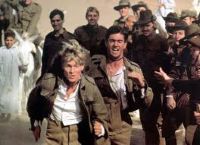
“Archie”
Source:Thuppahis
Michael Roberts, being an abridged version of an old article presented in the Library of Social Science run by Richard Koenigsberg and others.
Addressing the practices of remembrance in Australia, Richard Koenigsberg has noted the irony that a battlefield defeat at Gallipoli in World War One, 1915, served a people as an emblem of nationhood: the “Australian nation, came into being on the foundations provided by the slaughter of its young men.”
There is more irony. The commemoration of Australian courage, sacrifice and manliness at Gallipoli (and subsequently on the Somme) was threaded by tropes of youthful innocence that drew on classical Hellenic motifs. While the monuments and epitaphs that were crafted in Australia to mark this event were manifestly Greek in form. The gendered masculine metaphor, in turn, was often embodied in the seminal image of a full-bodied blonde young man. “Archie Hamilton” in Peter Weir’s classic film Gallipoli was/is one such trope (and he died of course).
The irony lies in the fact that such an iconic image is not unlike the archetype of the ideal German Aryan favored by the Nazis. The irony is compounded when we place the Australian creations of such motifs within a political context featured by hard-line policies known as “White Australia.” Soon after the six colonies constituted themselves as one colonial state in 1900/01, they instituted what is known as the “White Australia policy” through the Immigration Restriction Act of 1901—designed to exclude Oriental migrants, specifically Chinese and Kanaks.
Here, then, lay a specific twist to the strand of White racism that was one facet of the British Empire and European expansion in general. The British Empire was widely depicted in its friendly circles as a “Pax Britannica.” As such, its intellectuals saw themselves as repositories of European civilization. Classical Greece was seen as the founding father (note the masculine) of this dispensation.
Gallipoli lay within the geographical arena of Greek civilization and the battles there evoked the stories of Sparta and its many epic battles, including those with Athens and the Delian League as well as the battle of Leuktra with the Thebians. Among the war correspondents in the thick of Gallipoli was C. E.W. Bean, a Tasmanian educated at Hertford College, Oxford.


Charles Bean survived to become one of Australia’s leading historians and the hand fashioning many of the monuments and memorializing activities of the emerging young nation during the interwar years. Ken Inglis has documented the degree to which Bean’s thinking was influenced by Greek architecture and history. By way of example, “the official letterhead for the Australia War Memorial is drawn from one of Bean’s favorite passages, a Periclean oration by Thucydides” (Flaherty & Roberts, 1989:60).

Significantly, Englishmen participated in the creation of what we call “The Anzac Legend.” The erudite reports on the war from Ellis Ashmead-Bartlett, ex Marlborough College, was one such force. As vitally, one of the earliest Anzac Day ceremonies was held at the Westminster Cathedral on 25th April 1916—with typical Christian trappings.
These cross fertilizations were not surprising. The vast majority of Australians were of British descent, with the largest component being English. Though there were tensions and disputes between mother-country and the colonists in the 1890s and 2000s, the British were kith and kin. British achievements and its imperial reach were admired.
Australian men enlisted in the fighting services in droves when Australia entered the World War in support of mother-country, while their womenfolk backed them to the hilt and even sent chicken feathers to some men who hesitated to enlist. In joining the war the Australians were addressing Britain more than anyone else: they would prove their mettle. It was going to be “a baptism of fire,” and thereby a passage to nationhood. Britain and the British were the principal audience.
Behind these ideological currents, moreover, were themes of manliness common to much of Europe. The late nineteenth century and early twentieth century were characterized by what is known as “muscular Christianity.” Baden-Powell’s Boy Scout movement, the popularity of athletic gymkhanas in Britain and the proliferation of youth gymnastics in Germany were among the currents of masculine endeavour that were held in high regard as builders of discipline and morality.


Such practices served as a platform for war. Indeed, after Germany’s disastrous defeat in World War I and the debilitating punishments imposed on the state by the Treaty of Versailles, the Weimar Republic carefully nourished gymnastic clubs as a platform for future military renewal. The Nazi movement took these activities a step further. Both literally and metaphorically, young and disciplined Aryan males were to be the spearhead of their panzers.
Muscular Christianity and Masculine Valour, therefore, was the bedrock of Power for both sides in the warring European world. The Allied high command thought the war would be over soon. Both Allies and Axis generals pursued similar military tactics on land involving attacks en masse. The result was massive slaughter on the battlefields of Europe and mountains upon mountains of grief—row upon row of gravestones, each deemed to embody a “supreme sacrifice” on behalf of one’s nation state.
That Australia and Australians were enmeshed in this ideology of sacrificial death is not surprising. This does not mean that there were no Australian twists in this story of the Anzac Legend. Elaborating upon these strands is another story: readers of this essay are advised to pursue their explorations by beginning with (a) the writings of Bruce Kapferer and (b) the recent e-book that has presented a compendium of articles on the Anzac Commemoration in order to mark the 100th anniversary of that sacred ceremony, one that is at once secular, religious and far-reaching.
*** *
Please send comments for Library of Social Science ….. oanderson@libraryofsocialscience.com