eLanka

Saturday, 28 Mar 2026
  • Home
  • Read History
  • Articles
    • eLanka Journalists
  • Events
  • Useful links
    • Obituaries
    • Seeking to Contact
    • eLanka Newsletters
    • Weekly Events and Advertisements
    • eLanka Testimonials
    • Sri Lanka Newspapers
    • Sri Lanka TV LIVE
    • Sri Lanka Radio
    • eLanka Recepies
  • Gallery
  • Contact
Newsletter
  • eLanka Weddings
  • Property
  • eLanka Shop
  • Business Directory
eLankaeLanka
Font ResizerAa
Search
  • Home
  • Read History
  • Articles
    • eLanka Journalists
  • Events
  • Useful links
    • Obituaries
    • Seeking to Contact
    • eLanka Newsletters
    • Weekly Events and Advertisements
    • eLanka Testimonials
    • Sri Lanka Newspapers
    • Sri Lanka TV LIVE
    • Sri Lanka Radio
    • eLanka Recepies
  • Gallery
  • Contact
Follow US
© 2005 – 2026 eLanka Pty Ltd. All Rights Reserved.
Home » Goodnews Stories Srilankan Expats » Articles » Gal Potha (Stone Book) – inscription of yore By Arundathie Abeysinghe
ArticlesArundathie Abeysinghe

Gal Potha (Stone Book) – inscription of yore By Arundathie Abeysinghe

eLanka admin
Last updated: December 17, 2021 1:32 am
By
eLanka admin
ByeLanka admin
Follow:
Share
5 Min Read
SHARE
Views: 10

Gal Potha (Stone Book) – inscription of yore

By Arundathie Abeysinghe

Gal Potha (Stone Book) - inscription of yore By Arundathie Abeysinghe


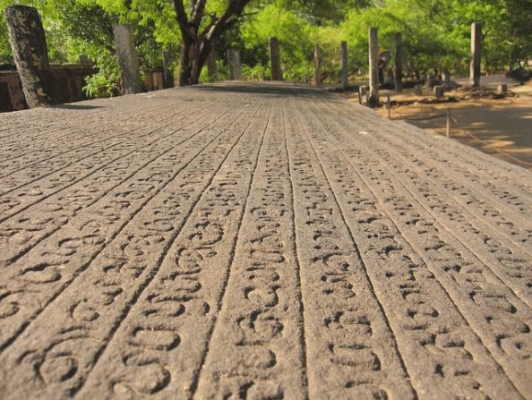
Gal Potha (Stone Book), a renowned inscription describing tasks of King Nissanka Malla (1187-1196) of *Polonnaruwa Kingdom, considered as an inscription of self-appraisal (of King Nissanka Malla) is a massive slab 8.2 meters long (26 feet 10 inches) and 1.4 meters broad (4 feet 7 inches). Gal Potha is placed between the eastern outer wall of *Hetadage and *Sathmahal Prasada.

The text in the Inscription is written in three columns and contains over 4300 characters in 72 rows. The letters of the inscription have been gilded with molten iron. The stone slab is an inscription about King Nissanka Malla, his rule, his heroic and altruistic deeds including his contribution to develop Polonnaruwa Kingdom as well as his eligibility for assuming the position of a king. Scholars are of the view that Gal Pota had been done during the ninth year of King Nissankamalla’s reign.

The Inscription, the longest inscription discovered in Sri Lanka is considered of immense historical and archaeological value. The Inscription is of immense value as it is a major source of information about the reign of King Nissankamalla. According to scholars, as the Inscription resembles an *ola leaf, it is known as “Gal Potha”. The writing on the Inscription is on the smooth upper surface of the slab and has been divided into three partitions. According to indications, the Inscription had been raised on a brick podium underpinned with short pillars and sheltered with a canopy supported by 10 stone pillars. The weight of the rock slab is approximately 15 tons.

Archaeologists are of the view that the letters of the Inscriptions date to 12th century characters of Sinhala Language. According to information in the Inscription, the stone slab had been brought from Mihintale, situated in close proximity to *Anuradhapura, approximately 100 kilometers from Polonnaruwa.
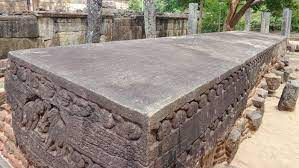
Gal Potha (Stone Book) - inscription of yore By Arundathie Abeysinghe

According to scholars, there are signs that liquidized metal has been poured onto the carved characters to bring out the letters clearer. There are also beautiful carvings of two rows of swans (hansa in Sinhala) that form the border of the side of the rock. Between the swan design, there is a carved seated figure of Goddess Lakshmi (Goddess of Prosperity) holding two flowers and two elephants pouring water on her from a container at the center. The addition with the elephants is a design known as the “Gajalakshmi”.

Scholars are of the view that the figure of Goddess Lakshmi may have been carved due to Hindu influence during Polonnaruwa era.

  • Anuradhapura – A major city in Sri Lanka, the capital of Anuradhapura District.
  • Chola conquest – This was a military invasion of the Anuradhapura Kingdom by the Chola Empire of Southern India, one of the longest ruling dynasties in world history. Initially, the Anuradhapura Kingdom was invaded in 993 AD and absorbed it into the Chola Empire of Southern India.
  • Hetadage – This is an ancient relic shrine in Polonnaruwa. During the Polonnaruwa Kingdom, it had been used as a relic chamber where the relics of the Buddha had been placed for veneration. The Hetadage has two floors.
  • Ola leaf – Palm leaf used for traditional writing in ancient times. The leaves are from the talipot tree (Corypha umbraculifera). During the latter part of the first century BC, Buddisht monks inscribed teaching of the Buddha through oral tradition on ola leaves, some of which are preserved to date.
  • Polonnaruwa – The Kingdom of Polonnaruwa or the ancient city of Polonnaruwa (also known as Pulastipura) was the second capital of Sri Lanka for three centuries from 11th to 13th centuries. After the *Chola conquest of Anuradhapura Kingdom, the center of administration was shifted to Polonnaruwa until 1232. Polonnaruwa has been declared a World Heritage Site by UNESCO.
  • Satmahal Prasada – The Satmahal Prasada (seven-story tower) is a 12th century seven storied stepped pyramid located in an elevated area in the northeast corner of Polonnaruwa. Scholars are of the view that this is an unusually shaped stupa (dagoba) built during the Polonnaruwa era (11th -13th century AD). The structure has entrances on all four sides as well as an additional staircase to reach the upper levels.

Image courtesy – ResearchGate & Lanka Travel Directory

TAGGED:Anuradhapuraathmahal PrasadaGal Potha (Stone Book)King Nissanka MallaOla leafPolonnaruwa Kingdom
Share This Article
Facebook Whatsapp Whatsapp LinkedIn Email Copy Link Print
Previous Article The World in Turmoil - Ecologically; Spiritually; Economically; and Politically - by Noor Rahim The World in Turmoil – Ecologically; Spiritually; Economically; and Politically – by Noor Rahim
Next Article CandleAid newsletter - “It is better by far to light a solitary candle than to curse the darkness” CandleAid newsletter – “It is better by far to light a solitary candle than to curse the darkness”
FacebookLike
YoutubeSubscribe
LinkedInFollow
Most Read
10 Pictures With Fascinating Stories Behind Them!

“A PICTURE SPEAKS A 1000 WORDS” – By Des Kelly

Look past your thoughts so you may drink the pure nectar of this moment

A Life Hack for when we’re Burnt Out & Broken Down – By Uma Panch

Narration of the History of our Proud Ancestral (Orang Jawa) Heritage. by Noor R. Rahim

eLanka Weddings

eLanka Marriage Proposals

Noel News

Noel News

Noel News

Noel News- By Noel Whittaker

EILEEN MARY SIBELLE DE SILVA (nee DISSANAYAKE) – 29 September 1922 – 6 April 2018 – A Woman of Value an Appreciation written by Mohini Gunasekera

K.K.S. Cement Factory

Dr.Harold Gunatillake’s 90th Birthday party

Sri Lanka's women's cricket squad in Melbourne

Cricket: Sri Lanka’s women’s squad in Melbourne

- Advertisement -
Ad image
Related News
Extreme Heat in Sri Lanka
Articles Bhanuka Nuwan

Extreme Heat in Sri Lanka: Causes, Science, and How to Protect People

Sri Lankan Aluwa Recipe – A Simple Traditional Sweet Delight - By Nadeeka - eLanka
Articles Nadeeka Kumari

Sri Lankan Aluwa Recipe – A Simple Traditional Sweet Delight – By Nadeeka – eLanka

Dilruk Jayasinghe is Sri Lanka's pride at the Australian Comedy Festival. - BY TREVINE RODRIGO IN MELBOURNE.
Articles Trevine Rodrigo

Dilruk Jayasinghe is Sri Lanka’s pride at the Australian Comedy Festival.- BY TREVINE RODRIGO IN MELBOURNE.

New wildlife underpass at Galgamuwa – solution for Human-Elephant Conflict By Arundathie Abeysinghe According to scholars, the new wildlife underpass at Galgamuwa in North Western Province which will be completed this month, will be a solution for the Human-Elephant Conflict (HEC). Galgamuwa is part of the Mahaweli Development Programme, the largest multipurpose national development programme in the country. Currently, construction of the elephant underpass is being completed beneath the railway line at Kasikote, between Galgamuwa and Ambanpola, an area well-known for frequent elephant crossings. A tunnel is constructed beneath the railway track to allow wild elephants to move safely from one side to the other, reducing the risk of train collisions as well as HEC. In 1977, when the Accelerated Mahaweli Development Scheme was launched, vast extents of forest lands were logged to facilitate new settlements. This led to elephants losing their habitats. According to senior engineers working on the project site, “construction work is expected to be completed in March 2026. The project would have been completed in early March, yet, the design phase of the project could not be finalised as there were challenges in controlling the movements of elephants towards the villages. During the rainy season, the slope that had already been cut was filled with water. Hence, those issues had to be addressed prior to its completion.” Galgamuwa residents are of the view that “this is a key project that should have been completed several decades ago as over 300 people have died in the area due to HEC, while over 50 people are handicapped as a large number of houses were damaged by elephants in search of food. For many years, we have spent sleepless nights due to fear of elephants roaming villages at night. One or two officers of the Department of Wildlife Conservation (DWC) cannot handle several elephants at once.” According to environmentalists “due to new settlements, there is lack of food in existing elephant migratory routes. To prevent elephant encounters, majority of villagers have set up electric fences which are useless as elephants cross the fences by felling large trees over them.” “Kahalla-Pallekele sanctuary was declared in 1989 with the objective of declaring the area up to Kala Wewa and Balalu Wewa as a national park. Yet, after this declaration, illegal land grabbing and human activities have disturbed migratory routes that elephants have been using for many years. Subsequent governments dug trenches, thinking that it would discourage elephants from coming towards villages. But that too was unsuccessful. Elephants now destroy electric fences because there’s lack of maintenance. It is difficult for just one or two wildlife officers to manage these elephant fences. When there’s lack of fodder, they go to people’s backyards in search of vegetables and fruits grown in home gardens.” In certain areas of Galagamuwa, community-based seasonal paddy field fences are constructed to avoid HEC. These are very successful as there is a direct incentive for the farmers to maintain and monitor the fence as their crops may be raided by elephants. In 2024, there were around 300 seasonal paddy field fences erected by Farmer Organisations supported by the Department of Agrarian Development. These seasonal paddy field fences contributed significantly to the number of elephant deaths decreasing from 488 in 2023 to 386 in 2024 as people kill elephants mainly when they raid their paddy or vegetable crops. Scholars are of the view that “although, the project would be completed this month, it is necessary to monitor, at least for a period of one year, if elephants may get used to using the underpass, even though they may not use it immediately.”
Articles Arundathie Abeysinghe

New wildlife underpass at Galgamuwa – solution for Human-Elephant Conflict – By Arundathie Abeysinghe

Australia to host U19 women’s tri-series in April
Articles

Australia to host U19 women’s tri-series in April

  • Quick Links:
  • Articles
  • DESMOND KELLY
  • Dr Harold Gunatillake
  • English Videos
  • Sri Lanka
  • Sinhala Videos
  • eLanka Newsletters
  • Obituaries
  • Sunil Thenabadu
  • Dr. Harold Gunatillake
  • Tamil Videos
  • Sinhala Movies
  • Trevine Rodrigo
  • Photos
  • eLanka Newsletter

eLanka

Your Trusted Source for News & Community Stories: Stay connected with reliable updates, inspiring features, and breaking news. From politics and technology to culture, lifestyle, and events, eLanka brings you stories that matter — keeping you informed, engaged, and connected 24/7.
Kerrie road, Oatlands , NSW 2117 , Australia.
Email : info@eLanka.com.au / rasangivjes@gmail.com.
WhatsApp : +61402905275 / +94775882546
  • About eLanka
  • Terms & Conditions

Disclaimer:
eLanka is committed to sharing positive and community-focused stories. We do not publish or endorse political, religious, or ethnic viewpoints. The content published on eLanka, including articles and newsletters, reflects the opinions and views of the respective authors and not those of eLanka. eLanka accepts no responsibility or liability for the accuracy, completeness, or consequences of any content provided by contributors.

(c) 2005 – 2025 eLanka Pty Ltd. All Rights Reserved.