eLanka

Saturday, 28 Mar 2026
  • Home
  • Read History
  • Articles
    • eLanka Journalists
  • Events
  • Useful links
    • Obituaries
    • Seeking to Contact
    • eLanka Newsletters
    • Weekly Events and Advertisements
    • eLanka Testimonials
    • Sri Lanka Newspapers
    • Sri Lanka TV LIVE
    • Sri Lanka Radio
    • eLanka Recepies
  • Gallery
  • Contact
Newsletter
  • eLanka Weddings
  • Property
  • eLanka Shop
  • Business Directory
eLankaeLanka
Font ResizerAa
Search
  • Home
  • Read History
  • Articles
    • eLanka Journalists
  • Events
  • Useful links
    • Obituaries
    • Seeking to Contact
    • eLanka Newsletters
    • Weekly Events and Advertisements
    • eLanka Testimonials
    • Sri Lanka Newspapers
    • Sri Lanka TV LIVE
    • Sri Lanka Radio
    • eLanka Recepies
  • Gallery
  • Contact
Follow US
© 2005 – 2026 eLanka Pty Ltd. All Rights Reserved.
Home » Goodnews Stories Srilankan Expats » Articles » Why do we need Food when we are hungry? by Dr harold Gunatillake – Health writer
Articles

Why do we need Food when we are hungry? by Dr harold Gunatillake – Health writer

admin
Last updated: September 19, 2016 10:58 am
By
admin
Share
9 Min Read
SHARE
Views: 3

Why do we need Food when we are hungry?

by Dr harold Gunatillake – Health writer

Why-do-we-need-Food

We all love food whether we are in the hunger mode or not. Have you ever thought what mechanism works in the body to make you feel hungry?

Michael Lowe, a professor of psychology at Drexel University in Philadelphia says this about hunger. “Feeling hungry can mean at least two things, and they are pretty different”

There is the traditional concept of hunger when you haven’t eaten for a couple of hours, and you would feel and complain that you are hungry. Children would cry and get irritable when they get the traditional hunger pains. Your stomach start making noises, you find it difficult to concentrate on what you are doing, and the urge for food becomes a priority.

Professor Lowe says,” This feeling of hunger stems from your body’s need for calories; the need for energy prompts the signal that it’s time to eat”.
This hunger is referred to as “Homeostatic hunger.” It is driven by a series of signals originating in the brain to tell us we need food for fuel said Dr. Amy Rothberg, director of the Weight Management Clinic and an assistant professor of internal medicine in the University of Michigan Health System’s Division of Metabolism.

We need approximately, 1,200 calories to run all the machinery in the body and for basic activities like talking, walking, sleeping and so on. The rest of calories from food another 800 cals are used for your daily activities.

Hormones in the body send signals to the brain when you are hungry. The most important hormone is called ghrelin- also referred as “hunger hormone” start rising in the blood stream to signal the brain. It is released primarily in the stomach and is thought to signal hunger to the brain. Immediately you start eating, the brain suppresses the release of this hormone. This is due to certain satiety responses which signal fullness in your belly which tells the brain that “we are getting enough food”.

When you are getting with the consumption of the food another set of opposing signals take part. They are hunger stimulating peptides called “oreigenic hormones and hunger suppressing anorexigenic hormones.

Dr Amy Rothberg said these hormones that are responsible for telling the brain that a person needs to eat or that a person feels full.

One should eat nutritious foods- a balanced diet with carbs, fats and proteins with a desert of fruits to feel full and satisfied.

A diet containing fibre and lean proteins keeps you feeling full more than eating processed starchy foods. For example white rice a staple diet among Sri Lankans gets digested and absorbed fast making you hungry quite fast. Eating unprocessed red or brown rice keeps you full much longer. Sri Lankans are fortunate that there are many local high fibre fruits like jak, Kohila roots, many varieties of yams, and high fibre fruits to feel full for a long time, without feeling hungry. Rothberg says that protein diet is the most filling of the macronutrients. Eat an egg in the morning for breakfast you could wait without being hungry till mid-day.

Artificial sweeteners

You should be careful of these zero calorie foods like the artificial sweeteners. They can confuse the brain with fullness signals to signify that you have not eaten enough when you have and the brain may secrete hormones for you to eat more. As a consequence taking non-calorie sweeteners make you more over-weight rather than slimming.

People wanting to lose weight should avoid artificial sweeteners for the same reason.

The gut microbes don’t seem to like artificial sweeteners either. They seem to convert these sweeteners into sugar in the gut and make the situation worse.
Ruthberg pointed out that these sweeteners may impact feelings of hunger and fullness.

Other than the homeostatic hunger so far discussed, we have another type called “hedonic hunger’. In this type of hunger there is no craving, and wanting to eat feeling. Lowe published in the journal Physiology & Behaviour that the term “hedonic hunger” was coined in 2007. He said that the most widely accepted theory was the human predisposition to high palatable foods.

Today, most people don’t cook at home, but prefer to relax in the restaurant and have a palatable meal with plenty of sugar and salt. Hunger is not the important element here. Lowe said that people wanted to eat even when they don’t need. Hunger and hormonal signals are not priorities in hedonic hunger. Hunger may come due to the smell and the visual display, probably after a glass of red wine, company and the ambience. It is more seeking pleasurable time rather than hunger need.
The need for calories for metabolic processes come from hunger signals as described earlier. In hedonic hunger it is the pleasure that attracts the palatable food.
A good example as Lowe puts it, “A person who hasn’t eaten in 12 or more hours is experiencing homeostatic hunger, whereas a person who wants dessert after finishing a filling meal is experiencing hedonic hunger.

Hedonic hunger is addictive in certain societies. People must for health reasons avoid highly palatable tempting foods out of the house, said Lowe. Hedonic hunger is harmful, subjected to obesity, heart disease, high blood pressure and so on.

Role of Leptins

Functions and need of ghrelin has been discussed briefly above. Leptin is also another hormone secreted by the fat cells, is a mediator of long term regulation of energy balance, by suppressing food intake. As mentioned earlier ghrelin in comparison is a fast-acting hormone functioning as a role in meal initiation and increasing ones appetite.

Both hormones participate in energy or calorie balance. Obese people the level of leptin seems to be increased, whereas ghrelin hormone secretion is decreased. Leptin though functions as a food suppressant is resistant in obese subjects. It is possible that abnormalities in the leptin and ghrelin systems may be contributing to the development of obesity among people.

In children having anorexia nervosa ghrelin levels seem to be high and decreased in obese children.

Appetite suppressant leptin is much less secreted in thin people and high in fat people as mentioned previously.

In conclusion, when the body needs food hunger pains are brought about by signals from the brain and ghrelin seems to be released by the stomach lining. The moment you initiate eating leptin an appetite suppressant would be secreted by the fat cells.

A balance in secretion of both hormones governs the energy levels and weight control.

Sorry, leptin is not marketed as a supplement to solve our obesity problem globally.

Some ref to ‘The Science of Hunger: How to Control It and Fight Cravings’
By Sara G. Miller, Staff Writer | April 1, 2016 07:27am ET


TAGGED:Dr. Harold Gunatillake
Share This Article
Facebook Whatsapp Whatsapp LinkedIn Email Copy Link Print
Previous Article Is Microwaved Food safe? Written by Dr harold Gunatillake-Health writer
Next Article Naomi and the Boys the best of Collection – by Patrick Ranasinghe
FacebookLike
YoutubeSubscribe
LinkedInFollow
Most Read
10 Pictures With Fascinating Stories Behind Them!

“A PICTURE SPEAKS A 1000 WORDS” – By Des Kelly

Look past your thoughts so you may drink the pure nectar of this moment

A Life Hack for when we’re Burnt Out & Broken Down – By Uma Panch

Narration of the History of our Proud Ancestral (Orang Jawa) Heritage. by Noor R. Rahim

eLanka Weddings

eLanka Marriage Proposals

Noel News

Noel News

Noel News

Noel News- By Noel Whittaker

EILEEN MARY SIBELLE DE SILVA (nee DISSANAYAKE) – 29 September 1922 – 6 April 2018 – A Woman of Value an Appreciation written by Mohini Gunasekera

K.K.S. Cement Factory

Dr.Harold Gunatillake’s 90th Birthday party

Sri Lanka's women's cricket squad in Melbourne

Cricket: Sri Lanka’s women’s squad in Melbourne

- Advertisement -
Ad image
Related News
Extreme Heat in Sri Lanka
Articles Bhanuka Nuwan

Extreme Heat in Sri Lanka: Causes, Science, and How to Protect People

Sri Lankan Aluwa Recipe – A Simple Traditional Sweet Delight - By Nadeeka - eLanka
Articles Nadeeka Kumari

Sri Lankan Aluwa Recipe – A Simple Traditional Sweet Delight – By Nadeeka – eLanka

Dilruk Jayasinghe is Sri Lanka's pride at the Australian Comedy Festival. - BY TREVINE RODRIGO IN MELBOURNE.
Articles Trevine Rodrigo

Dilruk Jayasinghe is Sri Lanka’s pride at the Australian Comedy Festival.- BY TREVINE RODRIGO IN MELBOURNE.

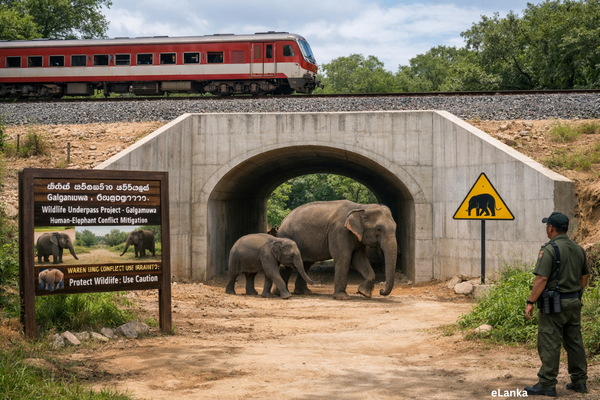
New wildlife underpass at Galgamuwa – solution for Human-Elephant Conflict By Arundathie Abeysinghe According to scholars, the new wildlife underpass at Galgamuwa in North Western Province which will be completed this month, will be a solution for the Human-Elephant Conflict (HEC). Galgamuwa is part of the Mahaweli Development Programme, the largest multipurpose national development programme in the country. Currently, construction of the elephant underpass is being completed beneath the railway line at Kasikote, between Galgamuwa and Ambanpola, an area well-known for frequent elephant crossings. A tunnel is constructed beneath the railway track to allow wild elephants to move safely from one side to the other, reducing the risk of train collisions as well as HEC. In 1977, when the Accelerated Mahaweli Development Scheme was launched, vast extents of forest lands were logged to facilitate new settlements. This led to elephants losing their habitats. According to senior engineers working on the project site, “construction work is expected to be completed in March 2026. The project would have been completed in early March, yet, the design phase of the project could not be finalised as there were challenges in controlling the movements of elephants towards the villages. During the rainy season, the slope that had already been cut was filled with water. Hence, those issues had to be addressed prior to its completion.” Galgamuwa residents are of the view that “this is a key project that should have been completed several decades ago as over 300 people have died in the area due to HEC, while over 50 people are handicapped as a large number of houses were damaged by elephants in search of food. For many years, we have spent sleepless nights due to fear of elephants roaming villages at night. One or two officers of the Department of Wildlife Conservation (DWC) cannot handle several elephants at once.” According to environmentalists “due to new settlements, there is lack of food in existing elephant migratory routes. To prevent elephant encounters, majority of villagers have set up electric fences which are useless as elephants cross the fences by felling large trees over them.” “Kahalla-Pallekele sanctuary was declared in 1989 with the objective of declaring the area up to Kala Wewa and Balalu Wewa as a national park. Yet, after this declaration, illegal land grabbing and human activities have disturbed migratory routes that elephants have been using for many years. Subsequent governments dug trenches, thinking that it would discourage elephants from coming towards villages. But that too was unsuccessful. Elephants now destroy electric fences because there’s lack of maintenance. It is difficult for just one or two wildlife officers to manage these elephant fences. When there’s lack of fodder, they go to people’s backyards in search of vegetables and fruits grown in home gardens.” In certain areas of Galagamuwa, community-based seasonal paddy field fences are constructed to avoid HEC. These are very successful as there is a direct incentive for the farmers to maintain and monitor the fence as their crops may be raided by elephants. In 2024, there were around 300 seasonal paddy field fences erected by Farmer Organisations supported by the Department of Agrarian Development. These seasonal paddy field fences contributed significantly to the number of elephant deaths decreasing from 488 in 2023 to 386 in 2024 as people kill elephants mainly when they raid their paddy or vegetable crops. Scholars are of the view that “although, the project would be completed this month, it is necessary to monitor, at least for a period of one year, if elephants may get used to using the underpass, even though they may not use it immediately.”
Articles Arundathie Abeysinghe

New wildlife underpass at Galgamuwa – solution for Human-Elephant Conflict – By Arundathie Abeysinghe

Australia to host U19 women’s tri-series in April
Articles

Australia to host U19 women’s tri-series in April

  • Quick Links:
  • Articles
  • DESMOND KELLY
  • Dr Harold Gunatillake
  • English Videos
  • Sri Lanka
  • Sinhala Videos
  • eLanka Newsletters
  • Obituaries
  • Sunil Thenabadu
  • Dr. Harold Gunatillake
  • Tamil Videos
  • Sinhala Movies
  • Trevine Rodrigo
  • Photos
  • eLanka Newsletter

eLanka

Your Trusted Source for News & Community Stories: Stay connected with reliable updates, inspiring features, and breaking news. From politics and technology to culture, lifestyle, and events, eLanka brings you stories that matter — keeping you informed, engaged, and connected 24/7.
Kerrie road, Oatlands , NSW 2117 , Australia.
Email : info@eLanka.com.au / rasangivjes@gmail.com.
WhatsApp : +61402905275 / +94775882546
  • About eLanka
  • Terms & Conditions

Disclaimer:
eLanka is committed to sharing positive and community-focused stories. We do not publish or endorse political, religious, or ethnic viewpoints. The content published on eLanka, including articles and newsletters, reflects the opinions and views of the respective authors and not those of eLanka. eLanka accepts no responsibility or liability for the accuracy, completeness, or consequences of any content provided by contributors.

(c) 2005 – 2025 eLanka Pty Ltd. All Rights Reserved.