“Slaves built Galle Fort” – By Des Kelly
Something, that I am afraid, not too many of us would have ever known, but for the fact that we “live & learn” until we die. I have always considered myself to be an avid reader, from a very early age, and always having been interested in the history of the Land of my birth, always imagined that the Galle & Colombo Forts were built by the Dutch who “ruled” the Island from 1640-1796, during which time, it was a combined effort of the Portuguese and the Sinhalese Kings co-ruled Ceylon, constantly fighting and “bickering” with each other, like, as the Sinhalese say, two
“Pora-Kikili” (fighting cocks, or hens, as the case may be).
So, I thought to myself, it was perhaps better that my ancestral predecessors “took over”. The Dutch, I thought, wonderful “builders”, as they were supposed to be, would put a stop to all this “in-fighting” in old Ceylon, would build their famous dams, bridges & forts and kick the Portuguese out, in the process. This, they did, and yes, just as the name says, it was the very famous “Dutch Galle Fort”, and I always took pride in thinking that the “Dutchies” had done this, BUT, unfortunately folks, according to this latest “Print Edition”, written by Jeevan Thiagarajah, the Dutch were more “slave-drivers” than “builders” and the Dutch and Colombo Forts, plus all the other bloody Dams, Bridges etc., etc., were actually built by AFRICAN SLAVES, especially slave-driven to do all the work, and, as such, should take all the credit for structures that still stand, today. Folks, please do read this very interesting piece, and, thank you Jeevan, for enlightening us.

Desmond Kelly. (for eLanka)
INTERESTING, IF YOU DID;NT KNOW
Slaves built Galle Fort – By Jeevan Thiagarajah
Source: Daily News
http://www.dailynews.lk/2019/03/25/features/181177/slaves-built-galle-fort )
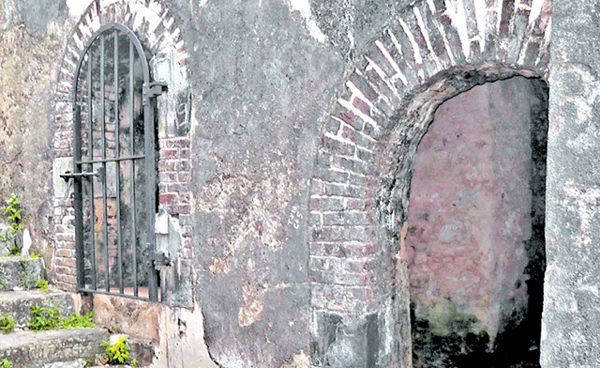
Entrance to the slave cells, Galle Fort. – Pinterest
The topic of the piece today was triggered by a conversation with the current High Commissioner in Colombo from South Africa, Ruby Marks, who has also posted on her Facebook page this passage, “Calvin Gilfillan, Head of Die Kasteel, affirmed what we suspected-the Dutch conceptualised and supervised, but it was the labour of an estimated 15,000 Africans brought from Portuguese and Dutch colonies, that did the back breaking work of actually building the Fort and the other ones scattered across Sri Lanka. I was shocked by how little was known in Sri Lanka about this. I visited the cramped quarters where the slaves were kept, the dungeons where they were imprisoned, and the cemetery-now a car park where they were buried. And my heart wept.
“Today there are only about 30 Mozambican/Sri Lankan descendants left, and they still try to hold onto the culture through dance and language. In our meeting today, I proposed that the descendants of these African men, who were brought here as slaves and whose contribution has never been acknowledged, should be honoured. And so with their help, we will perform a cleansing ceremony at the dungeon and at the car park where they are buried. We will also unveil a plaque so that their sacrifice and tears will never be forgotten. We will also, with Die Kasteel, arrange a symposium between the Fort here and our Kasteel, and if we can, exchange researchers. I’m determined that the contribution of the people from our motherland, taken against their will to labour in Sri Lanka until they died, will not be forgotten”.
Slavery in Africa
The course of human history is marked by appalling crimes. But even the hardened historian is filled with horror, loathing and indignation on examining the record of African slavery. How was it possible? How could it have gone on for so long, and on such a scale? A tragedy of such dimensions has no parallel in any other part of the world.
The African continent was bled of its human resources via all possible routes. Across the Sahara, through the Red Sea, from the Indian Ocean ports and across the Atlantic. At least ten centuries of slavery for the benefit of the Muslim countries (from the ninth to the nineteenth). Then more than four centuries (from the end of the fifteenth to the nineteenth) of a regular slave trade to build the Americas and the prosperity of the Christian states of Europe. The figures, even where hotly disputed, make your head spin. Four million slaves exported via the Red Sea, another four million through the Swahili ports of the Indian Ocean, perhaps as many as nine million along the trans-Saharan caravan route, and eleven to twenty million (depending on the author) across the Atlantic Ocean.
Why the Africans rather than other peoples? Who exactly should be held responsible for the slave trade? The Europeans alone, or the Africans themselves?
Even after the abolition of the slave trade in Africa, Colonial powers used forced labour — such as in King Leopold’s Congo Free State (which was operated as a massive labour camp) or as libertos on the Portuguese plantations of Cape Verde or São Tomé.
The great slaving companies were formed in the second half of the seventeenth century, when the Americas, and other parts of the world which the Treaty of Tordesillas (1494) and various papal edicts had reserved to the Spaniards and Portuguese, were redistributed among the nations of Europe. The whole of Europe – France, England, Holland, Portugal and Spain, and even Denmark, Sweden and Brandenburg shared in the spoils, establishing a chain of monopoly companies, forts, trading posts and colonies that stretched from Senegal to Mozambique. Only distant Russia and the Balkan countries were missing from the pack – and they received their own small contingents of slaves via the Ottoman Empire. The Start of the Trans-Atlantic Slave Trade.
When the Portuguese first sailed down the Atlantic African coast in the 1430s, they were interested in one thing: gold. However, by 1500 they had traded already 81,000 Africans to Europe, nearby Atlantic islands, and to Muslim merchants in Africa.
The ‘Triangular Trade’ in slaves
For two hundred years, 1440-1640, Portugal had a monopoly on the export of slaves from Africa. It is notable that they were also the last European country to abolish the institution — although, like France, it still continued to work former slaves as contract labourers, which they called libertos or engagés à temps. It is estimated that during the 4 1/2 centuries of the trans-Atlantic slave trade, Portugal was responsible for transporting over 4.5 million Africans (roughly 40% of the total). During the eighteenth century, however, when the slave trade accounted for the transport of a staggering 6 million Africans, Britain was the worst transgressor — responsible for almost 2.5 million. (This is a fact that is often forgotten by those who regularly cite Britain’s prime role in the abolition of the slave trade.)
Information on how many slaves were shipped from Africa across the Atlantic to the Americas during the sixteenth century can only be estimated as very few records exist for this period. But from the seventeenth century onwards, increasingly accurate records, such as ship manifests, are available.
Throughout the Vereenigde Oostindische Company (‘Dutch East India Company’, VOC) empire, mobility and coercion were key elements in mobilizing labour and maintaining imperial order. Throughout the Asian empire of the VOC, various circuits ensured the continuous mobility of coerced labour. These dynamics of slavery and the slave trade seem to have existed before European powers arrived in South and Southeast Asia.
The arrival of the Portuguese, the Dutch and other European trading companies meant the intensification of long-range slave trading networks. The trading companies of the Dutch, English, French and other European nations started to build upon existing trading patterns throughout the Indian Ocean area and Southeast Asia. In this way, European demand for both slaves and Asian commodities resulted in the intensification of the slave trade throughout the Indian Ocean world.
Throughout the seventeenth and eighteenth centuries, the slave trade in Asia was conducted by both European and Asian traders. Gujarati merchants transported enslaved Mozambicans to Daman and Diu. The two major players in Maluku trade, including slavery, were the Chinese and the Bugis. As in Maluku, Chinese slave traders were the major players in the export of Balinese slaves, mostly to Batavia, in the seventeenth and eighteenth centuries.
Ceylon could perhaps best be described as the second most important region in the VOC empire. After Batavia, the Ceylonese port cities of Colombo and Galle were the most important destinations for the intercontinental shipping of the VOC between Asia and Europe. From the 1660s onwards, three to four ships per year would sail directly to Ceylon from the Republic, while 5 to sometimes 10 or even 15 ships would depart from Ceylon to the Republic via the Cape.
Presence of slaves in Ceylon
Slavery is a little-studied subject in Sri Lankan history for the simple reason that slaves and slavery do not immediately surface in Sri Lankan memory, nor in colonial and indigenous texts. Slavery as such was not new to Sri Lanka, and at least from the Portuguese period onwards, slaves had been actively imported into the island. According to late seventeenth- century censuses, slaves formed the larger part of the urban inhabitants in the coastal port cities.
Tamara Fernando from the University of Cambridge has written on the historical aspects. She states that in 1660, the Dutch East India Company (VOC) transported more than 10,000 slaves from the Subcontinent to Ceylon and Batavia, and the slave trade was an incredibly lucrative side business for VOC officials. Slaves were used for construction work alongside prisoners, mostly as domestic workers for wealthy local and Dutch elites at a time when well-to-do families could have up to 20 slaves. Over time, these slaves were often absorbed into what the historians call the ‘urban underclass’. The proceedings from the Dutch Council of Justice in Colombo, preserve the lives and testimonies of many slaves. These cases were filed by the slaves for their manumission (freedom) or, more tragically, in the case of their murder, rape or abuse.
Commemorating the memory of the victims
In commemoration of the memory of the victims, the General Assembly, in its resolution 62/122 of December 17, 2007, declared March 25 the International Day of Remembrance of the Victims of Slavery and the Transatlantic Slave Trade, to be observed annually.
The resolution also called for the establishment of an outreach programme to mobilize educational institutions, civil society and other organisations to inculcate in future generations the “causes, consequences and lessons of the transatlantic slave trade, and to communicate the dangers of racism and prejudice.” This piece is captures some facets of the slave trade. An honest remembrance of their unfortunate time in Ceylon would require further committed work.