Sri Lanka’s Garment Industry: Strengths and Global Impact – By Malsha – eLanka
Sri Lanka’s garment and apparel industry is far more than just a key economic sector—it is a global player known for quality, ethical practice, and innovation. Over the past five decades, the island nation has transformed from a modest textile producer into one of the world’s respected apparel exporters, earning a reputation that goes beyond volume to include values, sustainability, and social responsibility.
A Legacy of Growth
The journey of Sri Lanka’s garment sector began in the 1960s with the establishment of early textile mills and small garment factories. However, real expansion took shape in the 1970s and 1980s when economic liberalization and the creation of free trade zones—such as the Katunayake Free Trade Zone—opened the door to international buyers. Pioneering firms like Hirdaramani, MAS Holdings, and Brandix played transformative roles in building production capacity, training skilled labor, and attracting global orders.
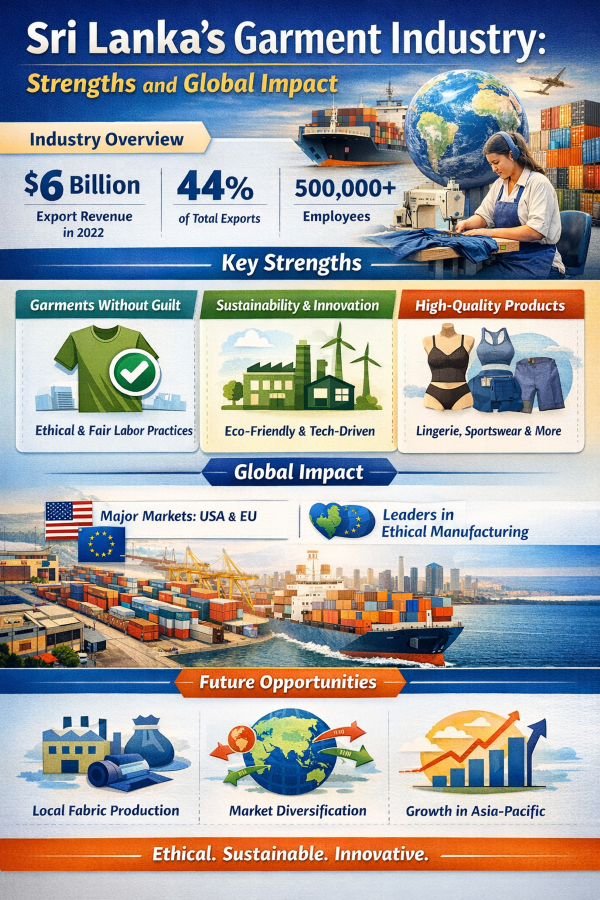
Since then, the apparel industry has grown into the leading export sector of Sri Lanka, contributing around 44–46% of total exports and providing employment to hundreds of thousands of workers, particularly women. In 2022 alone, the sector’s export value reached nearly $6 billion, with aspirations to reach $8 billion by 2025 through enhanced innovation and expanded supply chains.
Strengths That Set Sri Lanka Apart
Ethical Manufacturing and “Garments Without Guilt”
One of the most distinctive attributes of Sri Lanka’s garment industry is its ethical orientation. The internationally respected slogan “Garments Without Guilt” encapsulates the country’s commitment to fair labor practices, safe working conditions, decent wages, and zero tolerance for child or forced labour. This ethical stance has become a global selling point, appealing to Western buyers and conscious consumers who increasingly value transparency and responsibility in supply chains.
Factories in Sri Lanka frequently undergo independent audits to ensure compliance, and many produce goods in environments that promote worker councils, mutual dialogue between employees and management, and generous employee benefits. Unlike many global apparel hubs, Sri Lanka maintains high labour standards without resorting to exploitative practices—a competitive edge in an era when ethics really do influence buying decisions.
Innovation and Sustainability
Sri Lankan apparel manufacturers have not only embraced ethical practices—they are also innovating in sustainability and technology. The country is home to the world’s first eco-friendly “Green Garment Factory” and Asia’s first CarbonNeutral® certified factory, alongside numerous facilities with LEED platinum ratings. Investments in renewable energy, waste reduction systems, and low carbon production processes have helped reduce environmental impact while meeting global Environmental, Social, and Governance (ESG) standards.
Innovation goes beyond sustainability. Many manufacturers are incorporating advanced technologies such as AI-driven production systems, 3D design and virtual sampling, and real-time supply tracking to improve efficiency and product quality. These tech-enabled processes help Sri Lankan companies stay competitive and attractive to major global brands.
Quality and Product Range
Sri Lanka is known for producing high-quality garments, including niche categories such as lingerie, activewear, swimwear, tailored clothing, and performance textiles. With extensive experience in handling diverse product specifications, local producers satisfy exacting standards required by premium international brands. It is common to find Sri Lankan-made products under labels sold by global retailers across Europe and North America.
This focus on quality over mere quantity differentiates Sri Lanka from low-cost producers that compete mostly on price. While the island may not match the sheer volume from Bangladesh or Vietnam, its reputation for reliability, compliance, and superior products gives it a unique position in global supply chains.
Global Impact and Market Reach
Sri Lankan apparel is truly global in reach. The United States and European Union remain major destinations, with many renowned brands sourcing production from Sri Lanka. Some of the world’s biggest fashion labels have long-standing partnerships with Sri Lankan manufacturers, appreciating both the ethical reputation and delivery reliability the country offers.
Beyond raw export figures, Sri Lanka’s impact also shows in how it shapes global perceptions of ethical sourcing. In recent years, sustainability has gone from a niche preference to a key factor in corporate procurement strategies. Sri Lanka’s leadership in green factory standards and responsible production has become a benchmark for other countries aspiring to attract premium buyers who are willing to pay for value that aligns with their global commitments.
Challenges and the Changing Global Landscape
Despite its strengths, Sri Lanka’s garment sector faces notable challenges. Increased global competition from countries like Bangladesh, Vietnam, and Cambodia—often driven by lower production costs or more favourable tariff structures—has put pressure on Sri Lanka’s export competitiveness. Currency fluctuations, rising costs, and tariff barriers further complicate the outlook.
For example, shifts in U.S. tariff policy have influenced Sri Lankan apparel exports, prompting companies and government bodies to strategise around diversification and market access to retain competitive footing. Even with ethical and sustainability credentials, Sri Lanka must continuously innovate and adapt to maintain growth in evolving global markets.
Future Outlook and Opportunities
The future of Sri Lanka’s garment industry lies in expanding value-added services, strengthening local supply chains, and diversifying market access. Investment in fabric manufacturing within the country could reduce dependence on imports, lower production costs, and improve eligibility for preferential trade agreements. Supporting small and medium enterprises with access to capital and technology will also help broaden the sector’s base and resilience.
There is also growing opportunity in Asia-Pacific markets—especially China and India—where increasing middle-class demand and changing fashion preferences could open new export avenues beyond traditional Western markets. By combining its ethical brand, technological adoption, and strategic trade partnerships, Sri Lanka can position itself as a holistic provider of apparel solutions, not just a manufacturer.
Conclusion
Sri Lanka’s garment industry is a story of transformation. From early industrial beginnings, it has become a symbol of responsible manufacturing, blending ethical labour practices, sustainability, and technological innovation. Its global influence goes beyond export statistics—Sri Lanka has helped redefine what it means to be a reputable apparel producer in the 21st century.
While competition, economic shifts, and global trade pressures present ongoing challenges, the strengths of the Sri Lankan apparel sector—built on quality, trust, and conscientious production—offer a solid foundation for future growth and global impact.