


‘The King of Cocoa’ who was too smart for the Brits-by KKS Perera
Source:Dailymirror
43rd Commemoration of Upali Wijewardene
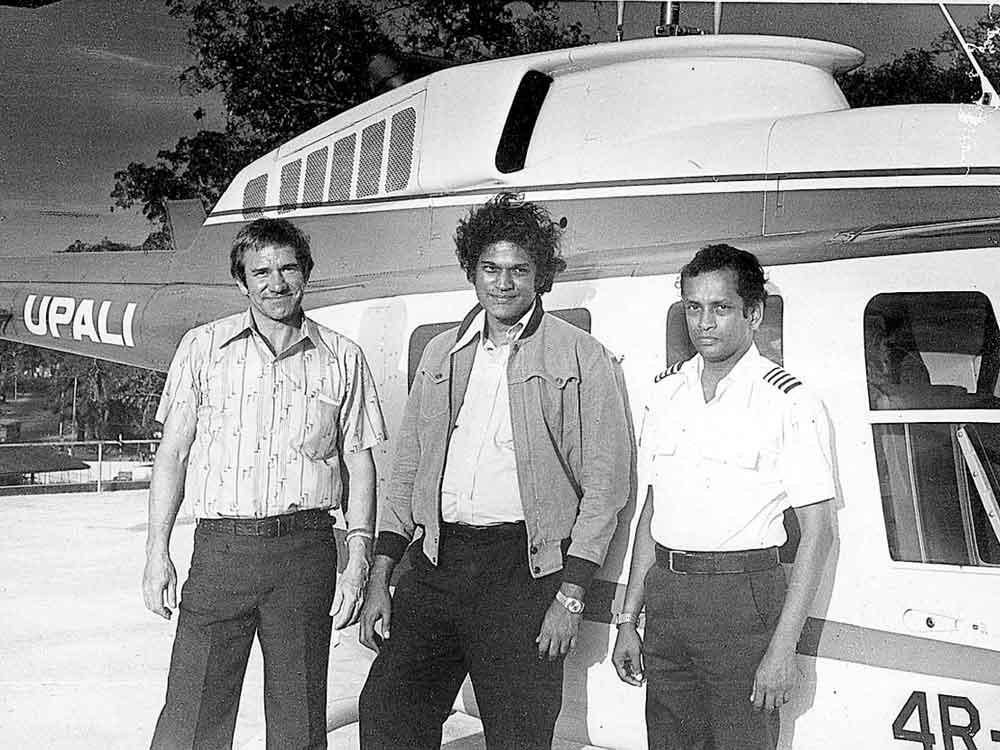
The picture shows Upali Wijewardene (Centre) with his Lear Jet
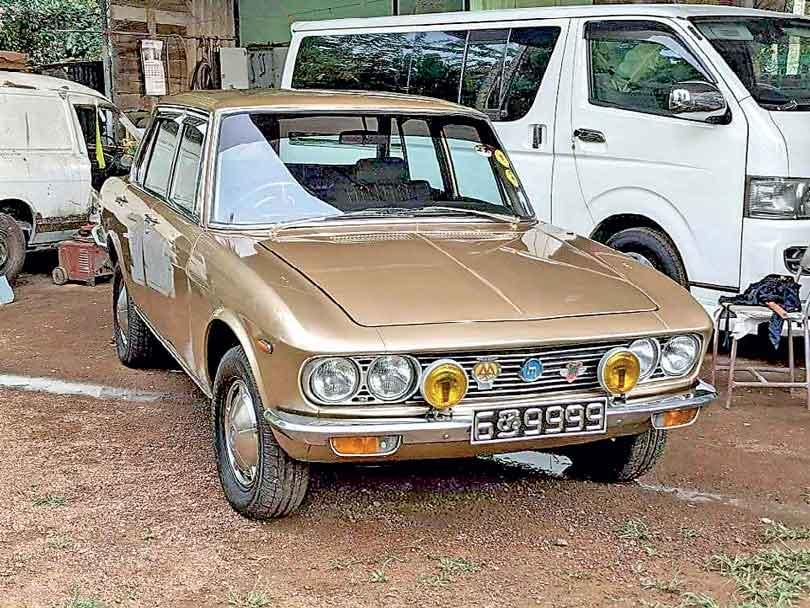
UMC Mazda 1500 (Upali Mazda)
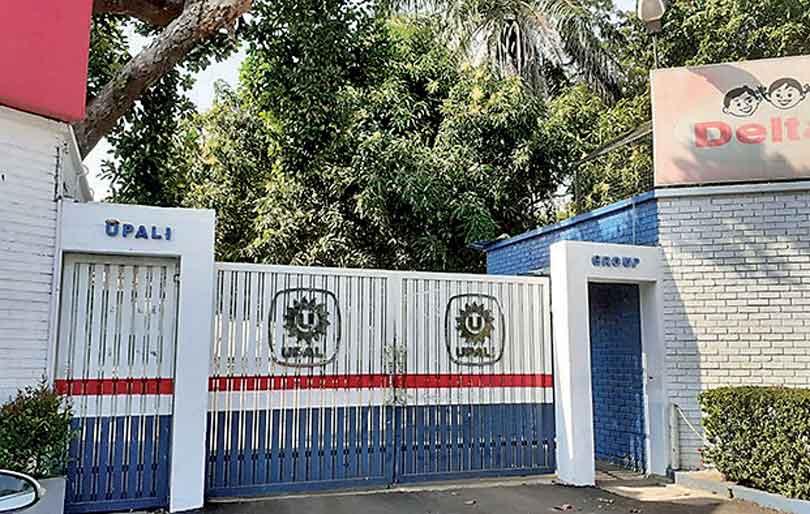
Upali Group Head Office on Bloemendhal Rd
Upali’s persistence became legendary throughout Colombo’s business circles
Under his leadership, Kandos established factories in Malaysia and Singapore, achieving market dominance within two years
At a certain point, Upali grew tired of merely making money and sought excitement beyond the balance sheet

The tension in the Shaw Wallace & Hedges boardroom was palpable that day in the mid-1970s. Around the polished mahogany table sat the board of directors of a multinational conglomerate with over a century of unbroken dominance in Tea Industry and Ceylon’s markets. The writer, who had joined as a school leaver and served the firm for sixteen years, witnessed the confrontation that would become legendary. At the head sat Eric Shattock, the European director overseeing the Asian region and former local chairman, a man accustomed to deference from local businessmen.
But the young Sri Lankan entrepreneur facing them showed no deference whatsoever.
Having recently acquired Ceylon Chocolates Ltd, he delivered an ultimatum: agree to modify the Kandos chocolate formula to suit local palates, or lose the distribution rights to the market-leading brand they had held since inception. The white sahibs were incredulous. Who was this upstart dictating terms to a company that had weathered two world wars and countless colonial upheavals?
The young man remained adamant. The Europeans refused. The meeting ended in a bitter stalemate.
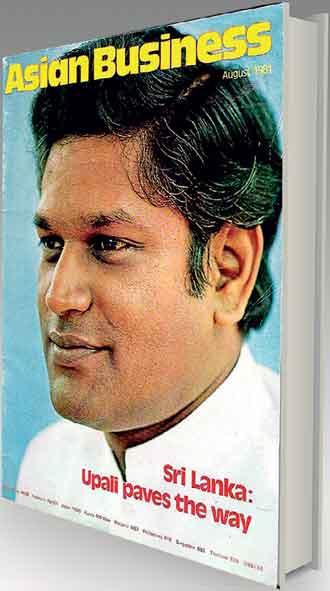
Upali Wijewardene the business tycoon who had transformed from a confectionery maker into Sri Lanka’s first multinational business magnate is pictured here in the 1981 August edition of the Asian Business magazine
Within weeks, he had cancelled the agreement and seized distribution rights for himself. At a somber staff meeting convened after the loss, Shattock, who had seen everything in his decades with the firm—shook his head with grudging admiration: “This guy is too smart for us.”
That young man was Philip Upali Wijewardene. Years later, he would write candidly: “I joined Lever Brothers as a management trainee just to learn how large multinationals work.” He had been studying them all along, learning their strengths, identifying their weaknesses, preparing to beat them at their own game.
The vanishing
On the evening of February 13, 1983, Upali’s Lear Jet lifted off from Subang International Airport in Kuala Lumpur. Fifteen minutes into the flight, at precisely 9:02 p.m., the aircraft disappeared from radar screens while cruising at 27,000 feet over the Straits of Malacca. Inside were six people, including the flamboyant tycoon who had transformed from a confectionery maker into Sri Lanka’s first multinational business magnate. The plane, scheduled to arrive in Colombo, never reached its destination. Despite an extensive international search operation involving multiple nations, it vanished without a trace, solidifying Upali’s transformation from business icon to eternal enigma. The nation remained gripped by the mystery for months as newspapers reported little else.
Born on February 17, 1938, in Kamburupitiya to the distinguished Sedawaththa Walawwa family, Upali seemed destined for the conventional path of Sri Lanka’s anglicised elite. His grandmother was the renowned Helena Wijewardena. Tragedy struck when his father died in 1939, just a year after Upali’s birth.
After primary education in Kamburupitiya and Colombo, he attended Royal College before earning second-class honours in Economics at Cambridge University in 1956. Yet unlike his privileged peers pursuing law, medicine, or academia, Upali chose entrepreneurship—a path that would redefine Sri Lankan business.
Building an empire from toffee
After quitting Lever Brothers following a heated argument with senior management, leaving his salary on the table, Upali purchased a sugar ball-making machine from former colleague Rajaram. With his grandmother’s support, he established Delta Toffee on Blumendhal Avenue.
Initial attempts failed disastrously, the toffee dissolved too quickly to reach consumers. Within a year, Delta Toffee dominated the market. His persistence became legendary throughout Colombo’s business circles. When seeking a wrapper design in the mid-1960s, one advertising designer rejected him five consecutive times before finally relenting to the relentless entrepreneur.
Diversifying rapidly
Upali diversified rapidly and strategically. He introduced the “Unic” radio, customised for every Sri Lankan province, from village chiefs to paddy farmers, everyone could now afford quality broadcasting. He ventured into gem exports from Ratnapura, channelling profits into vehicle manufacturing. The Upali Mazda and Upali Fiat, produced at his Homagama factory, became household names. His Kandos triumph, the very confrontation witnessed at Shaw Wallace & Hedges, transformed him into an international player. Having acquired Ceylon Chocolates Ltd, he expanded aggressively. Under his leadership, Kandos established factories in Malaysia and Singapore, achieving market dominance within two years. Products reached Hong Kong, Thailand, and Australia. His reputation soared so high that Malaysian immigration officials didn’t recognise his name—only his title: “King of Cocoa.” At its peak, Kandos owned 40,000 acres of Cocoa in Malaysian land.
Political ambitions
At a certain point, Upali grew tired of merely making money and sought excitement beyond the balance sheet. He chose horse racing, the sport of kings. Beyond the thrill of winning, racing provided the high-profile image essential for dealing with international businessmen. True to character, he never discussed business failures, believing it would diminish his authority.
When the UNP came to power in 1977, President J.R. Jayewardene appointed him Director General of the Greater Colombo Economic Commission. His brilliance became legendary. During technical meetings with Irish engineers from Shannon Free Trade Zone, establishing the Katunayake Investment Promotion Zone, Upali grasped complex problems in seconds and delivered solutions; his speed stunned experienced foreigners.
By 1981, politics had replaced business as his central passion. He founded The Island and Divaina newspapers, launching fearless attacks on the establishment that spared no one. Finance Minister Ronnie de Mel regularly hurled thunderbolts against him in Parliament. Close friends warned him privately that attacking established politicians was deeply unwise, that veterans wouldn’t tolerate a newcomer upstaging them. Unfortunately, the sycophants now surrounding him, people he would normally never have tolerated, offered opposite advice and spent far more time at his ear. The warnings came to naught.
His Ruhunu Udanaya programme brought development to Kamburupitiya. The Upali Wijewardene Conference Hall at Narandeniya National School stands as enduring testimony.
Final flight
By 1982, Upali operated globally, purchasing a Lear Jet 35A. On February 13, 1983, he departed Malaysia with director Ananda Pelimuhandiram, Malaysian director S.M. Ratnam, assistant A. Senanayake, pilot Noel Francis Ignatius Anandappa, and co-pilot Sidney de Soysa. The aircraft took off at 8:47 p.m. with fuel for five and a half hours.
After requesting permission to climb to 27,000 feet at 8:56 p.m., the plane simply vanished. Eight minutes after reaching altitude, it disappeared from the radar. The mystery deepened when Medan Air Traffic Control failed to issue standard protocols, leaving Katunayake to sound the alarm.
The search became international. Indonesian and Malaysian forces, American Seventh Fleet ships, Australian planes, British assistance, Indian cooperation, Singaporean support, and a Soviet satellite joined the hunt. Only one piece was found: a right outboard wheel. Minister Lalith Athulathmudali later suggested sabotage as most likely.
Lasting Legacy
The nation remained transfixed for months. Newspapers reported little else. False alarms, including a Reuters report of wreckage found off Sumatra, kept hopes oscillating. Eventually, operations ceased. The riddle remained unsolved.
It was only through his disappearance, and its suddenness, that the full extent of Upali’s charisma became apparent. Nobody had foreseen the immense hold he had developed on ordinary Sri Lankans through his tremendous business strides, particularly abroad. The man in the street felt proud that a countryman could venture into the wide world and succeed with such panache. No man is without fault, but Upali had far more pluses than minuses.
At forty-five, he left behind a fortune and a young wife, Lakmini Ratwatte, niece of Prime Minister Sirimavo Bandaranaike. His disappearance sparked inheritance battles resolved only in 1999.
Four decades later, Upali Wijewardene remains Sri Lanka’s greatest entrepreneurial legend, a symbol of ambition, innovation, and tragic mystery. Whether he could have conquered politics as he conquered commerce remains one of history’s tantalising “ifs.” Like Icarus flying too close to the sun—Upali’s own business symbol, his brilliant ascent ended in inexplicable vanishing, ensuring his permanent place in Sri Lankan mythology as the tycoon who became a legend by disappearing into the vast emptiness of the night sky.
(The writer can be reached at kksperera1@gmail.com)