eLanka

Saturday, 28 Mar 2026
  • Home
  • Read History
  • Articles
    • eLanka Journalists
  • Events
  • Useful links
    • Obituaries
    • Seeking to Contact
    • eLanka Newsletters
    • Weekly Events and Advertisements
    • eLanka Testimonials
    • Sri Lanka Newspapers
    • Sri Lanka TV LIVE
    • Sri Lanka Radio
    • eLanka Recepies
  • Gallery
  • Contact
Newsletter
  • eLanka Weddings
  • Property
  • eLanka Shop
  • Business Directory
eLankaeLanka
Font ResizerAa
Search
  • Home
  • Read History
  • Articles
    • eLanka Journalists
  • Events
  • Useful links
    • Obituaries
    • Seeking to Contact
    • eLanka Newsletters
    • Weekly Events and Advertisements
    • eLanka Testimonials
    • Sri Lanka Newspapers
    • Sri Lanka TV LIVE
    • Sri Lanka Radio
    • eLanka Recepies
  • Gallery
  • Contact
Follow US
© 2005 – 2026 eLanka Pty Ltd. All Rights Reserved.
Home » Goodnews Stories Srilankan Expats » Articles » Australian minister dispatched to Sri Lanka to demand a halt to refugees fleeing destitution – By Max Boddy
Articles

Australian minister dispatched to Sri Lanka to demand a halt to refugees fleeing destitution – By Max Boddy

eLanka admin
Last updated: June 23, 2022 4:59 pm
By
eLanka admin
ByeLanka admin
Follow:
Share
10 Min Read
SHARE
Views: 0

Australian minister dispatched to Sri Lanka to demand a halt to refugees fleeing destitution – By Max Boddy

Source:wsws.org

Australia’s Labor government sent Home Affairs Minister Clare O’Neil to Sri Lanka last weekend to insist that President Gotabaya Rajapakse’s hated regime stop desperate asylum seekers leaving the poverty-stricken country.

Australian minister dispatched to Sri Lanka to demand a halt to refugees fleeing destitution - By Max Boddy
Australia’s Minister for Home Affairs, Clare O’Neil with Sri Lankan Minister of Foreign Affairs Prof. G. L. Peiris in Colombo [Image: Sri Lankan Ministry of Foreign Affairs]

On Monday, O’Neil met with Rajapakse, Prime Minister Ranil Wickremesinghe and Foreign Minister GL Peiris, demanding assurances they would continue to block boat departures and accept the forced return of passengers pushed back or detained by the Australian Border Force or Australia’s navy.

While O’Neil claimed her sudden visit was about assisting a country “facing very difficult times,” the Labor government’s purpose had nothing whatever to do with helping the masses of the island’s population. They face intolerable living conditions, including food and petrol shortages, skyrocketing prices and austerity measures imposed by the Rajapakse-Wickremesinghe government to satisfy the dictates of the International Monetary Fund.

On the contrary, the focus of O’Neil’s mission was to block people from trying to escape the social catastrophe to seek refuge in Australia. She reiterated the Labor government’s continuation of Operation Sovereign Borders, the militarised policy introduced by Australia’s previous Liberal-National Coalition government of forcibly turning back refugee boats or immediately deporting their passengers to face persecution or impoverishment in the countries they fled.

A statement issued by Rajapakse’s office said O’Neil told him that the Labor government was committed to Operation Sovereign Borders and would continue its “Zero Chance” advertising campaign in Sri Lanka to dissuade so-called illegal migration to Australia.

In the past few weeks, the Australian navy has intercepted at least four asylum seeker vessels from Sri Lanka. Some passengers have been taken to the notorious immigration prison on Christmas Island, an Australian outpost in the Indian Ocean, before being swiftly flown back to Sri Lanka, denying them the legal right to apply for asylum.

According to media reports, 23 Sri Lankans arrived back in the country on Monday after being flown out of Christmas Island on the weekend and were being interrogated at the airport. All were believed to be from the west coast towns of Negombo, Chilaw and Muttur.

During the same weeks, the Sri Lankan navy reportedly captured more than 400 asylum seekers.

Mass protests are continuing in Sri Lanka over sky-high food and fuel prices, shortages and power blackouts. In May, inflation reached 38 percent and food inflation 57 percent. Protestors are demanding the resignation of Rajapakse and his government.


Far from being concerned about the conditions of the workers and poor in Sri Lanka, the Australian government fears that the eruption of working-class struggle could trigger similar uprisings across the Indo-Pacific. Foreign Minister Penny Wong stated: “Not only do we want to help the people of Sri Lanka in its time of need, there are also deeper consequences for the region if this crisis continues.”

O’Neil announced a paltry $50 million in aid to the country, $22 million of which is to be given to the United Nations World Food Programme (WFP), and $5 million to other UN agencies. No details were provided about the remaining $23 million.

This is barely a drop in the ocean for a country with $US51 billion in foreign debt. Predictions are that by the end of the year 3 million people will rely on the WFP to survive. According to UN reports, at least 70 percent of the population are already reducing meals.

While making this announcement, O’Neil underlined the true thrust of her visit. “I want to convey Australia’s willingness to deepen our assistance through additional law enforcement cooperation, border protection capabilities and intelligence sharing measures,” she said.

On Tuesday, O’Neil and Sri Lankan Fisheries Minister Douglas Devananda opened a new $5 million Fisheries Monitoring Centre in Colombo. It is designed to monitor vessels by installing 4,200 GPS trackers, provided by the Australian government, on fishing boats.

When the system is fully operational, the centre can monitor all fishing ships. O’Neil said it would “assist us with the crucial task of combating transnational crime and people-smuggling operations.”

Combating “people smugglers” has been the pretext for the anti-refugee policy pioneered by the Australian government. Many reports highlight that most refugee boats are not owned by crime syndicates but by fishing families, who are themselves fleeing as they face destitution due to fuel shortages and rising prices.

Another Australian government concern is that the Sri Lankan navy will be unable to carry out the required boat intercepts due to fuel shortages. Across Sri Lanka, people are queuing for days for fuel and petrol bowsers are running dry, but the navy has been given priority status for “national security” reasons.

Seeking to reassure Australia, Sri Lanka Navy spokesman Captain Indika De Silva told the Australian media that while the shortage “does have an impact,” the navy’s fuel priority ensured that “so far we have been able to carry our duties at an appropriate level to counter the threats emanating from the maritime domain, including those illicit migration attempts.”

Some 50 Sri Lankan navy personnel are in Australia already on a “specialist training program.” Rajapakse’s regime also uses two retired Australian patrol boats and the two governments share intelligence information on refugee boats.

O’Neil’s visit is part of a frenetic series of trips by Albanese and other senior ministers across the region and internationally to reinforce the interests of Australian imperialism and help ramp up the Biden administration’s war preparations against China.

Rajapakse, who is also under ongoing US pressure over his turn to China for investment and aid, said he understood “Australia is on high alert for security in the Indian Ocean.” His official statement added that “the Sri Lankan government would extend its fullest support to maintain the Indian Ocean as a security zone.

O’Neil’s trip highlights the cynicism on display last week when Albanese posed for photos with the Nadesalingam Tamil refugee family.

The family had been imprisoned by the previous Coalition government since March 2018, after being arrested in a pre-dawn raid on their home in the central Queensland town of Biloela. The town’s residents launched a tireless campaign for their freedom, including nationwide protests.

The Albanese government granted the family a bridging visa, but not permanent residency, in a PR operation to gloss over the reactionary bipartisan anti-refugee policy.

In fact, the family’s persecution resulted from policies imposed by the previous Labor governments, those of prime ministers Rudd and Gillard. They reinstated the “Pacific solution” of locking up asylum seekers on the remote Nauru and Manus islands and declared that refugees arriving by boat would never be permitted to live in Australia.

In 2012, the Gillard government went further in violating the rights of refugees under international law. It struck an agreement with then-President Mahinda Rajapakse to immediately return all Sri Lankan asylum seekers who reached Australia by boat, preventing them from applying for refugee status.

O’Neil’s visit continues Labor’s filthy record, amid even more devastating conditions in Sri Lanka than during the 30-year communal war against Tamil separatists.

The intensifying persecution of asylum seekers is a warning to the working class. The rising costs of living and deteriorating social conditions in Sri Lanka are part of a global capitalist crisis, which is also battering working-class living conditions and fuelling strikes and protests in Australia.

There is not one rule for refugees and another for workers at home. Domestically as well, the ruling class and its governments, Labor and Coalition alike, will not hesitate to use similarly repressive military and police-state measures against working-class unrest.


TAGGED:Clare O’Neil .Gotabaya RajapakseRanil Wickremesinghe.Australian navy
Share This Article
Facebook Whatsapp Whatsapp LinkedIn Email Copy Link Print
Previous Article Asylum seekers to return to Sri Lanka after sea intercept Asylum seekers to return to Sri Lanka after sea intercept
Next Article Johnny Mathis - Unforgettable Johnny Mathis – Unforgettable
FacebookLike
YoutubeSubscribe
LinkedInFollow
Most Read
10 Pictures With Fascinating Stories Behind Them!

“A PICTURE SPEAKS A 1000 WORDS” – By Des Kelly

Look past your thoughts so you may drink the pure nectar of this moment

A Life Hack for when we’re Burnt Out & Broken Down – By Uma Panch

Narration of the History of our Proud Ancestral (Orang Jawa) Heritage. by Noor R. Rahim

eLanka Weddings

eLanka Marriage Proposals

Noel News

Noel News

Noel News

Noel News- By Noel Whittaker

EILEEN MARY SIBELLE DE SILVA (nee DISSANAYAKE) – 29 September 1922 – 6 April 2018 – A Woman of Value an Appreciation written by Mohini Gunasekera

K.K.S. Cement Factory

Dr.Harold Gunatillake’s 90th Birthday party

Sri Lanka's women's cricket squad in Melbourne

Cricket: Sri Lanka’s women’s squad in Melbourne

- Advertisement -
Ad image
Related News
Extreme Heat in Sri Lanka
Articles Bhanuka Nuwan

Extreme Heat in Sri Lanka: Causes, Science, and How to Protect People

Sri Lankan Aluwa Recipe – A Simple Traditional Sweet Delight - By Nadeeka - eLanka
Articles Nadeeka Kumari

Sri Lankan Aluwa Recipe – A Simple Traditional Sweet Delight – By Nadeeka – eLanka

Dilruk Jayasinghe is Sri Lanka's pride at the Australian Comedy Festival. - BY TREVINE RODRIGO IN MELBOURNE.
Articles Trevine Rodrigo

Dilruk Jayasinghe is Sri Lanka’s pride at the Australian Comedy Festival.- BY TREVINE RODRIGO IN MELBOURNE.

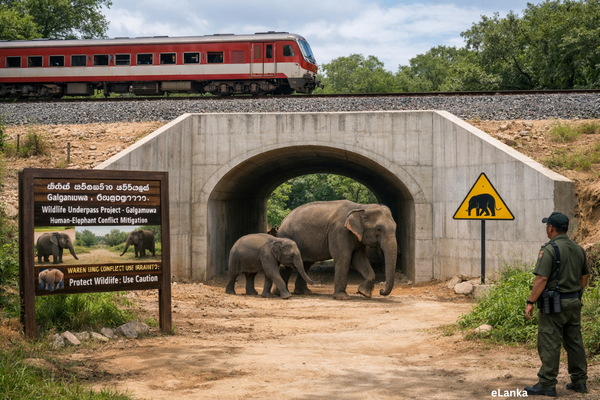
New wildlife underpass at Galgamuwa – solution for Human-Elephant Conflict By Arundathie Abeysinghe According to scholars, the new wildlife underpass at Galgamuwa in North Western Province which will be completed this month, will be a solution for the Human-Elephant Conflict (HEC). Galgamuwa is part of the Mahaweli Development Programme, the largest multipurpose national development programme in the country. Currently, construction of the elephant underpass is being completed beneath the railway line at Kasikote, between Galgamuwa and Ambanpola, an area well-known for frequent elephant crossings. A tunnel is constructed beneath the railway track to allow wild elephants to move safely from one side to the other, reducing the risk of train collisions as well as HEC. In 1977, when the Accelerated Mahaweli Development Scheme was launched, vast extents of forest lands were logged to facilitate new settlements. This led to elephants losing their habitats. According to senior engineers working on the project site, “construction work is expected to be completed in March 2026. The project would have been completed in early March, yet, the design phase of the project could not be finalised as there were challenges in controlling the movements of elephants towards the villages. During the rainy season, the slope that had already been cut was filled with water. Hence, those issues had to be addressed prior to its completion.” Galgamuwa residents are of the view that “this is a key project that should have been completed several decades ago as over 300 people have died in the area due to HEC, while over 50 people are handicapped as a large number of houses were damaged by elephants in search of food. For many years, we have spent sleepless nights due to fear of elephants roaming villages at night. One or two officers of the Department of Wildlife Conservation (DWC) cannot handle several elephants at once.” According to environmentalists “due to new settlements, there is lack of food in existing elephant migratory routes. To prevent elephant encounters, majority of villagers have set up electric fences which are useless as elephants cross the fences by felling large trees over them.” “Kahalla-Pallekele sanctuary was declared in 1989 with the objective of declaring the area up to Kala Wewa and Balalu Wewa as a national park. Yet, after this declaration, illegal land grabbing and human activities have disturbed migratory routes that elephants have been using for many years. Subsequent governments dug trenches, thinking that it would discourage elephants from coming towards villages. But that too was unsuccessful. Elephants now destroy electric fences because there’s lack of maintenance. It is difficult for just one or two wildlife officers to manage these elephant fences. When there’s lack of fodder, they go to people’s backyards in search of vegetables and fruits grown in home gardens.” In certain areas of Galagamuwa, community-based seasonal paddy field fences are constructed to avoid HEC. These are very successful as there is a direct incentive for the farmers to maintain and monitor the fence as their crops may be raided by elephants. In 2024, there were around 300 seasonal paddy field fences erected by Farmer Organisations supported by the Department of Agrarian Development. These seasonal paddy field fences contributed significantly to the number of elephant deaths decreasing from 488 in 2023 to 386 in 2024 as people kill elephants mainly when they raid their paddy or vegetable crops. Scholars are of the view that “although, the project would be completed this month, it is necessary to monitor, at least for a period of one year, if elephants may get used to using the underpass, even though they may not use it immediately.”
Articles Arundathie Abeysinghe

New wildlife underpass at Galgamuwa – solution for Human-Elephant Conflict – By Arundathie Abeysinghe

Australia to host U19 women’s tri-series in April
Articles

Australia to host U19 women’s tri-series in April

  • Quick Links:
  • Articles
  • DESMOND KELLY
  • Dr Harold Gunatillake
  • English Videos
  • Sri Lanka
  • Sinhala Videos
  • eLanka Newsletters
  • Obituaries
  • Sunil Thenabadu
  • Dr. Harold Gunatillake
  • Tamil Videos
  • Sinhala Movies
  • Trevine Rodrigo
  • Photos
  • eLanka Newsletter

eLanka

Your Trusted Source for News & Community Stories: Stay connected with reliable updates, inspiring features, and breaking news. From politics and technology to culture, lifestyle, and events, eLanka brings you stories that matter — keeping you informed, engaged, and connected 24/7.
Kerrie road, Oatlands , NSW 2117 , Australia.
Email : info@eLanka.com.au / rasangivjes@gmail.com.
WhatsApp : +61402905275 / +94775882546
  • About eLanka
  • Terms & Conditions

Disclaimer:
eLanka is committed to sharing positive and community-focused stories. We do not publish or endorse political, religious, or ethnic viewpoints. The content published on eLanka, including articles and newsletters, reflects the opinions and views of the respective authors and not those of eLanka. eLanka accepts no responsibility or liability for the accuracy, completeness, or consequences of any content provided by contributors.

(c) 2005 – 2025 eLanka Pty Ltd. All Rights Reserved.