eLanka

Saturday, 28 Mar 2026
  • Home
  • Read History
  • Articles
    • eLanka Journalists
  • Events
  • Useful links
    • Obituaries
    • Seeking to Contact
    • eLanka Newsletters
    • Weekly Events and Advertisements
    • eLanka Testimonials
    • Sri Lanka Newspapers
    • Sri Lanka TV LIVE
    • Sri Lanka Radio
    • eLanka Recepies
  • Gallery
  • Contact
Newsletter
  • eLanka Weddings
  • Property
  • eLanka Shop
  • Business Directory
eLankaeLanka
Font ResizerAa
Search
  • Home
  • Read History
  • Articles
    • eLanka Journalists
  • Events
  • Useful links
    • Obituaries
    • Seeking to Contact
    • eLanka Newsletters
    • Weekly Events and Advertisements
    • eLanka Testimonials
    • Sri Lanka Newspapers
    • Sri Lanka TV LIVE
    • Sri Lanka Radio
    • eLanka Recepies
  • Gallery
  • Contact
Follow US
© 2005 – 2026 eLanka Pty Ltd. All Rights Reserved.
Home » Goodnews Stories Srilankan Expats » Articles » Exodus of white South African cricket talent -by Rex Clementine
Articles

Exodus of white South African cricket talent -by Rex Clementine

eLanka admin
Last updated: November 30, 2020 2:07 pm
By
eLanka admin
ByeLanka admin
Follow:
Share
5 Min Read
SHARE
Views: 1

Exodus of white South African cricket talent -by Rex Clementine

South African cricket

Source:Island

Every time Sri Lankan teams go to South Africa, they ask the locals one question. ‘What happened to Marchant de Langa?’ The six foot seven inch tall quick, made his Test debut against the Sri Lankans in Durban in 2011. He took seven wickets in the first innings and his victims included Kumar Sangakkara, Angelo Mathews, and Tilan Samaraweera et al. Yet, after that, he was hardly heard of. So what actually happened to de Langa? Well, he turned ‘Kolpak’ preferring County Cricket in England instead of Test cricket for his country.

Isn’t that absurd? One may wonder. The ultimate joy for any player is to represent your country. That too, after you had proven yourself in Test cricket, why do you want to return to First Class cricket? Well, the reason being, white South African cricketers get a raw deal in their country and they are seeking greener pastures in Europe or in places like Australia and New Zealand. Not just cricketers, this includes farmers, businessmen and other professionals. Australia in particular welcomes South African farmers with open arms.

For decades, the black South Africans suffered at the hands of white rulers and those terrible apartheid laws not only segregated them but deprived them of equal opportunities. The world took notice and imposed trade embargos on South Africa. Sports associations followed banning bilateral sporting ties with South Africa and in the end; they were left with Hobson’s choice but to give in for fair play.

Sadly, now white South Africans are at the receiving end due to the ‘quota system’ that is prevalent across all walks of life. When seeking employment, black South Africans get the preference, followed by coloured and those of Indian origin and the whites come last. So opportunities for them are few and rare. In sports too talent alone won’t get you there. The quota system encourages more black South African representation and as a result the whites are moving out.

In the Lanka Premier League, two South Africans share the new ball for Jaffna Stallions – Kyle Abbott and Duanne Olivier. Both were successful international cricketers before they turned Kolpak settling in England to play County Cricket.

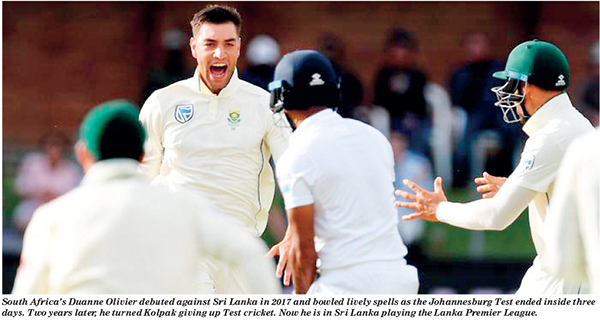
Abbott was playing the New Year Test against Sri Lanka in Cape Town in 2017. That he had signed a Kolpak deal was a poorly kept secret and the news was out during the Test match. Cricket South Africa reacted angrily and wanted to separate.  The fast bowler announced his retirement at the conclusion of the Test match. This was the second Test.  So for the third game in Johannesburg, the Proteas were short of a fast bowler. They drafted in Duanne Olivier.

Olivier on debut was on the money and his pace was too much to handle for the Sri Lankans. The game was lost inside three days. Two years later when Sri Lanka returned to South Africa, Olivier along with Kagiso Rabada was South Africa’s premier bowlers. Yet, after the second Test, Olivier too turned Kolpak and South Africa lost yet another fine talent in his prime.

All South Africans who have turned Kolpak are doing a terrific job for their respective counties. Their country meanwhile is struggling to make an impact in the sport. South Africa are ranked sixth in Tests and fifth in ODIs and T-20s. Not the true reflection of their sporting greatness.

What the Kolpak ruling means is that citizens of the country who have trade agreements with the European Union countries are eligible to work as locals. Now South Africa is not part of the EU, but they have a trade agreement with EU and that qualifies their citizens. So when English counties hire South Africans, it’s not considered an overseas signing.

In the last few years with Britain exiting from the European union more South Africans turned Kolpak in order to qualify. Cricket authorities in South Africa must be hoping that now their problems will end as Kolpak deal is no longer valid once Britain exits EU. However, unless they deal with serious issues like equal opportunities to all, they are going to face more problems.


TAGGED:Angelo MathewsKUMAR SANGAKKARATilan Samaraweera
Share This Article
Facebook Whatsapp Whatsapp LinkedIn Email Copy Link Print
Previous Article House of Commons to bring in resolution against SL at UN Human Rights Council sessions-By Yohan Perera and Ajith Siriwardana
Next Article 10 Fun Facts About Downy Woodpeckers
FacebookLike
YoutubeSubscribe
LinkedInFollow
Most Read
10 Pictures With Fascinating Stories Behind Them!

“A PICTURE SPEAKS A 1000 WORDS” – By Des Kelly

Look past your thoughts so you may drink the pure nectar of this moment

A Life Hack for when we’re Burnt Out & Broken Down – By Uma Panch

Narration of the History of our Proud Ancestral (Orang Jawa) Heritage. by Noor R. Rahim

eLanka Weddings

eLanka Marriage Proposals

Noel News

Noel News

Noel News

Noel News- By Noel Whittaker

EILEEN MARY SIBELLE DE SILVA (nee DISSANAYAKE) – 29 September 1922 – 6 April 2018 – A Woman of Value an Appreciation written by Mohini Gunasekera

K.K.S. Cement Factory

Dr.Harold Gunatillake’s 90th Birthday party

Sri Lanka's women's cricket squad in Melbourne

Cricket: Sri Lanka’s women’s squad in Melbourne

- Advertisement -
Ad image
Related News
The Brad & Kiara Show-eLanka
Articles The Brad and Kiara Show - Sydney

The Brad & Kiara Show

Extreme Heat in Sri Lanka
Articles Bhanuka Nuwan

Extreme Heat in Sri Lanka: Causes, Science, and How to Protect People

Sri Lankan Aluwa Recipe – A Simple Traditional Sweet Delight - By Nadeeka - eLanka
Articles Nadeeka Kumari

Sri Lankan Aluwa Recipe – A Simple Traditional Sweet Delight – By Nadeeka – eLanka

Dilruk Jayasinghe is Sri Lanka's pride at the Australian Comedy Festival. - BY TREVINE RODRIGO IN MELBOURNE.
Articles Trevine Rodrigo

Dilruk Jayasinghe is Sri Lanka’s pride at the Australian Comedy Festival.- BY TREVINE RODRIGO IN MELBOURNE.

New wildlife underpass at Galgamuwa – solution for Human-Elephant Conflict By Arundathie Abeysinghe According to scholars, the new wildlife underpass at Galgamuwa in North Western Province which will be completed this month, will be a solution for the Human-Elephant Conflict (HEC). Galgamuwa is part of the Mahaweli Development Programme, the largest multipurpose national development programme in the country. Currently, construction of the elephant underpass is being completed beneath the railway line at Kasikote, between Galgamuwa and Ambanpola, an area well-known for frequent elephant crossings. A tunnel is constructed beneath the railway track to allow wild elephants to move safely from one side to the other, reducing the risk of train collisions as well as HEC. In 1977, when the Accelerated Mahaweli Development Scheme was launched, vast extents of forest lands were logged to facilitate new settlements. This led to elephants losing their habitats. According to senior engineers working on the project site, “construction work is expected to be completed in March 2026. The project would have been completed in early March, yet, the design phase of the project could not be finalised as there were challenges in controlling the movements of elephants towards the villages. During the rainy season, the slope that had already been cut was filled with water. Hence, those issues had to be addressed prior to its completion.” Galgamuwa residents are of the view that “this is a key project that should have been completed several decades ago as over 300 people have died in the area due to HEC, while over 50 people are handicapped as a large number of houses were damaged by elephants in search of food. For many years, we have spent sleepless nights due to fear of elephants roaming villages at night. One or two officers of the Department of Wildlife Conservation (DWC) cannot handle several elephants at once.” According to environmentalists “due to new settlements, there is lack of food in existing elephant migratory routes. To prevent elephant encounters, majority of villagers have set up electric fences which are useless as elephants cross the fences by felling large trees over them.” “Kahalla-Pallekele sanctuary was declared in 1989 with the objective of declaring the area up to Kala Wewa and Balalu Wewa as a national park. Yet, after this declaration, illegal land grabbing and human activities have disturbed migratory routes that elephants have been using for many years. Subsequent governments dug trenches, thinking that it would discourage elephants from coming towards villages. But that too was unsuccessful. Elephants now destroy electric fences because there’s lack of maintenance. It is difficult for just one or two wildlife officers to manage these elephant fences. When there’s lack of fodder, they go to people’s backyards in search of vegetables and fruits grown in home gardens.” In certain areas of Galagamuwa, community-based seasonal paddy field fences are constructed to avoid HEC. These are very successful as there is a direct incentive for the farmers to maintain and monitor the fence as their crops may be raided by elephants. In 2024, there were around 300 seasonal paddy field fences erected by Farmer Organisations supported by the Department of Agrarian Development. These seasonal paddy field fences contributed significantly to the number of elephant deaths decreasing from 488 in 2023 to 386 in 2024 as people kill elephants mainly when they raid their paddy or vegetable crops. Scholars are of the view that “although, the project would be completed this month, it is necessary to monitor, at least for a period of one year, if elephants may get used to using the underpass, even though they may not use it immediately.”
Articles Arundathie Abeysinghe

New wildlife underpass at Galgamuwa – solution for Human-Elephant Conflict – By Arundathie Abeysinghe

  • Quick Links:
  • Articles
  • DESMOND KELLY
  • Dr Harold Gunatillake
  • English Videos
  • Sri Lanka
  • Sinhala Videos
  • eLanka Newsletters
  • Obituaries
  • Sunil Thenabadu
  • Dr. Harold Gunatillake
  • Tamil Videos
  • Sinhala Movies
  • Trevine Rodrigo
  • Photos
  • eLanka Newsletter

eLanka

Your Trusted Source for News & Community Stories: Stay connected with reliable updates, inspiring features, and breaking news. From politics and technology to culture, lifestyle, and events, eLanka brings you stories that matter — keeping you informed, engaged, and connected 24/7.
Kerrie road, Oatlands , NSW 2117 , Australia.
Email : info@eLanka.com.au / rasangivjes@gmail.com.
WhatsApp : +61402905275 / +94775882546
  • About eLanka
  • Terms & Conditions

Disclaimer:
eLanka is committed to sharing positive and community-focused stories. We do not publish or endorse political, religious, or ethnic viewpoints. The content published on eLanka, including articles and newsletters, reflects the opinions and views of the respective authors and not those of eLanka. eLanka accepts no responsibility or liability for the accuracy, completeness, or consequences of any content provided by contributors.

(c) 2005 – 2025 eLanka Pty Ltd. All Rights Reserved.