Geoffrey Bawa’s Architectural Work Deciphered Eloquently ….-by Dr. SinhaRaja Tammita-Delgoda
Source:Thuppahis
In The Sunday Times, November 2025, reviewing a new book on Geoffrey Bawa, ‘Geoffrey Manning Bawa- Decolonizing Architecture’ by architect-historian Shanti Jayewardene. The book, a landmark publication for the National Trust launched on November 30.
The golden afternoon seeps across the black and white tiles, lighting up the corridor of the Galle Face Hotel. It settles on a woman, standing by a door. She is locked in impassioned debate with a foreigner. The words “colonial,” “imperialistic” and “orientalist” hang like daggers in the air. The speaker had just come out of a conference on the decorative arts. A Sri Lankan living in England, she spoke with the heightened sensitivity and fervour that expatriates sometimes bring home.

The Parliamentarians’ aerial garden: Parliament of Sri Lanka
During her years in England, she had produced the first major study of Sri Lanka’s great architect Geoffrey Manning Bawa. Entitled The Work of Geoffrey Bawa: Some Observations Towards a Historical Understanding, this was her Masters dissertation at University College London. It was done two years before Brian Brace Taylor produced his book on Geoffrey Bawa (1986). Over the decades a stream of books and articles have emerged, amongst them David Robson’s monumental studies. This very first work however, has remained unpublished and largely unknown.
Almost seven years after returning to Sri Lanka, Dr. Shanti Jayewardene Pillai drawing on her training in architecture and her doctoral studies in imperial history, has combined her past research with wide-ranging fieldwork, a flair for theory and vast reading to produce an intellectual tour de force.
Geoffrey Bawa’s works are well documented. His mind and the influences which shaped him remain a mystery.
“He may be cajoled into talking about Italian gardens of the 16th century, it is left to the historian and the critic to situate his work within the context of architecture over the last twenty five years”
Brian Brace Taylor

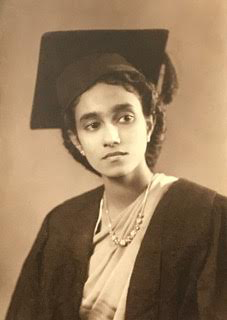
Dr. Shani Jayewardene
This is what Dr. Shanti Jayewardene has done. An architect, historian and critic, she situates Bawa within the social, intellectual and artistic environment in which he lived, worked and thought. As she observes “it was a journey shared with many intellectuals from all over the colonized world.” To become the architect that he finally became,“ Bawa had to unlearn a mindset trained not to question European superiority, to be willing to change, a captive mind required a special kind of intellect and a special kind of will.”
Driven to find his own identity, Bawa reached out of the isolation and alienation experienced by any non European growing up in a colonized world. Reinventing himself, he discovered the traditions of Sri Lanka’s architecture and reshaped the learning he had been taught. Making up his own rules, he embarked on a pathbreaking shift in architectural thought.
“It is obvious that there is no easy way, full of intellectual signposts, leading to good and satisfactory architecture. But there are rules…” Geoffrey Bawa
Like a surgeon, Jayewardene probes very deeply into the rules and theories of aesthetics which shaped Bawa’s universe. With delicate skill, her unrelenting intellect dissects and peels away the sources, inspirations and experiences which made up his world. In doing so she enables us to see what Bawa inherited and what he assimilated, where he followed the rules and where he made them up. Uncovering layer after layer, she reveals an eclectic depth and a great range of mind.
This book is a search for Bawa the thinker and Bawa the reader. Jayewardene establishes Bawa as both. Bawa only came to architecture late in life, after he had turned 33. His first degree was English Literature which he embarked on when he was only 19. This was a subject which required a great deal of reading. In a revealing conversation, Chloe de Soysa, recollects Bawa did read a lot and that he was fond of quoting. This is confirmed by his brother Bevis, who tells us that reading was one of his main forms of relaxation and that he habitually read half a book before falling asleep.

Entrance corridor of Bawa’s house on 33rd Lane, Colombo
We are also told that Bawa had one of the best collections of books on the island. Delving into this library to discover his mind, Jayewardene examines his reading with minute scrutiny. Through painstaking, meticulous research, associating people with books and time and place, Jayewardene builds up piece by piece, the picture of what Bawa might have read, when and where.
Jayewardene manages to trace the convergence of three main strands in Bawa’s early thinking. The first strand she unravels is the work of Ananda Coomaraswamy, who championed the cause of Sinhala art and design and called for Sri Lanka’s people to understand their past. The next thread is provided by the Indologist Arthur Basham, whose great work The Wonder That Was India came out in 1954, the same year that Bawa enrolled at the Architectural Association. The book was clearly important to Bawa, who bought it almost as soon as it came out. Basham sought to find a new way to write India’s ancient history in an era of decolonization and independence, Jayewardene suggests that this must have resonated with Bawa. In his essay A Way of Building (1968) Bawa admits … “We, have been forced to look at ourselves more closely.. In my personal search I have looked in to the past.”
The third strand which emerges is the influence of French literature, in particular the anti-colonial writings of André Gide. Through the discovery of two unknown letters, Jayewardene also manages to trace an interesting connection with the Negritude Movement of the 1930s, a French literary and philosophical movement which looked to integrate European and African ways of knowing and being.
The picture which Jayewardene assembles is of a man, whose “thought is deep, complex and riven with contradictions.” It is a portrait which tends to reinforce her opinion:
“No one can design like him because design is a thinking process.
Many people today think you can design without thinking.
Bawa could design like this because he read”
In her search for Bawa, Jayewardene takes us down several new pathways. Much of her research is startlingly original, unearthing the undiscovered, the unknown and the unthought of. Painstaking fieldwork and research has led her to the discovery of Kimbulapitiya, one of the childhood homes of the Bawa family. The hillside gardens of this estate were densely planted with trees and foliage which stood on narrow terraces. Revealing photographs bring Lunuganga into focus and it is clear that Kimbulapitiya cast a long shadow on the memories of both brothers.
Bawa’s use of blue tiles for his pools suggest a North African link to the author. Jayewardene’s journey takes her to Morocco, to the Al-Karaouine University in Fez which inspired the Alhambra and the ruins of the 16th century Al Badi Palace in Marrakesh. She also draws our attention to the Majorelle gardens in Marrakesh, created by French artist Jacques Majorelle in the first half of the 20th century. Here she observes the deep cobalt blue of the garden’s pools, also noting the books on Morocco which Bawa bought in Paris.

North African link: Blue pool, Jardin Majorelle, Marrakesh
The author also discovers parallels with the work of iconic Mexican architect Luis Barragán (1902 –1988). Developing his own version of modernism, Barragán infused it with the spirit of Mexico. Looking closely at Bawa’s domestic buildings, Jayewardene the architect sees echoes of Barragán in the stairs, courtyards, pools and spaces. Although the two never met, Bawa did spend six weeks in Mexico, he also owned a copy of I.E Myers seminal work Mexico’s Modern Architecture (1952) which features Barragán’s work.
The only text that Bawa ever acknowledged in print was Senake Bandaranayake’s Sinhalese Monastic Architecture (1974).For Bawa this was a new and critical source of knowledge; for the first time he could envisage the classical forms of Anuradhapura’s monasteries and he was able to grasp the concept of an elevated building surrounded by water. According to Jayewardene, his discovery of Senake Bandaranayake’s work led to a profound shift in Bawa’s thinking, transforming his designs for the new Parliament at Sri Jayewardenapura.
Jayewardene make us aware of the seminal importance of the “Giri” monasteries of ancient Anuradhapura in Bawa’s later work. These cave monasteries in the wilderness, with their gardens of rock, water and forest, where the buildings seem to flow with the landscape, had an impact on Bawa’s thinking. The chapter on Kandalama Hotel is based on the author’s experience of cave monasteries such Kudumbigala, Dowa and Dambulla.
According to Jayewardene, Kandalama is a reinterpretation of ancient design principles, a series of viewing platforms facing the horizon, arresting views of forests, silvery lakes and misty mountains. Exploring the ancient temple of Kudumbigala in Eastern Sri Lanka, she imagines what Bawa may have seen in his mind. The photographs too suggest astonishing and revealing parallels. In one of the most fascinating episodes in the whole book, Jayewardene imagines the ambience of shifting vistas of light and shade created by the interplay of forests, boulders and magnificent views. This, she argues, was the world which Bawa saw and which he set out to create.
Jayewardene’s sophisticated mind enables her to navigate her way through the complexities of theory, anthropology, aesthetics, architecture, history and politics with ease and confidence. Yet she is careful not to overreach herself and stretch her assumptions beyond the fact. Conversations and oral sources are an integral component of her methodology, guiding her next step. These primary sources however, are not included in the bibliography. For a scholar of this calibre, this is a surprising omission.
The cornerstone of Jayewardene’s method lies in her extensive fieldwork and her massive research. Her voyage through Sri Lanka’s environment, its history and its architecture gives the author a depth of sight which informs and anchors her understanding. The illustrations are an essential part of her argument, the photographs a mine of information which can be read as a narrative in themselves. Many of them are revealing, some are very rare.
For the National Trust this is an important work. It marks a departure from the established formula of competently produced coffee table books of general interest. This is an original work of scholarship and an important work of reference. It is made so by the use of footnotes, a proper bibilography and an index. These are the hallmarks of serious study. The author has been well advised to insist on this format; equally so the National Trust must be congratulated on recognizing the importance of this work and allowing it to take this shape.
The book will be available for sale at a pre-launch price of Rs. 3,750 at the launch on Thursday.
(Dr. SinhaRaja Tammita-Delgodais a historian, art historian, academic and writer. He has lectured in the USA, UK, India and Sri Lanka and is the author of several major works on the art and heritage of Sri Lanka, including The World of Stanley Kirinde (2005) and Ridi Vihare. The Flowering of Kandyan Art (2007) and Eloquence in Stone. The Lithic Saga of Sri Lanka (2008) in collaboration with Nihal Fernando and Studio Times)
| The launch |

“Geoffrey Manning Bawa – Decolonizing Architecture” by Dr. Shanti Jayewardene was launched on Thursday, November 30 at the HNB Auditorium, 22nd Floor, HNB Towers, 479 T.B. Jaya Mawatha, Colombo at 6.15 p.m. The book is published by the National Trust – Sri Lanka, together with the sponsors Aitken Spence Printing & Packaging (Pvt) Ltd. Dr. SinhaRaja Tammita-Delgoda introduced the book at the launch.