Major Harp (Harpa major): A Stunning Marine Treasure of Sri Lanka’s Coastal Waters – By Bhanuka – eLanka
Sri Lanka’s coastal waters are rich in marine biodiversity. Among the many fascinating sea creatures found around the island, the Major Harp (Harpa major) stands out for its beauty and unique shell structure. This marine gastropod belongs to the family Harpidae and attracts shell collectors and marine enthusiasts due to its elegant appearance and striking patterns.
The Major Harp is not a fish, but a sea snail. It lives in tropical and subtropical ocean waters, including parts of the Indian Ocean surrounding Sri Lanka. Its beautifully patterned shell resembles the strings of a harp, which inspired its common name.
Physical Description
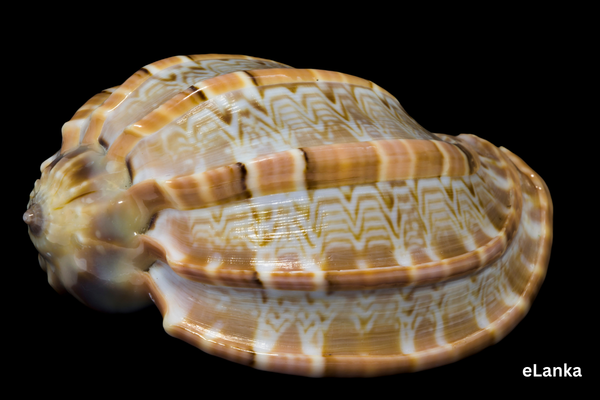
The shell of the Major Harp is large, smooth, and glossy. It has a rounded, slightly oval shape with well-defined ribs running vertically along its surface. These ribs resemble the strings of a harp, giving the shell its distinctive identity.
The shell usually displays a creamy white or pale background colour. Dark brown or reddish-brown bands appear between the ribs. These bold patterns make it one of the most visually attractive marine shells found in tropical waters.
An adult Harpa major can grow up to about 12 to 15 centimetres in length. Its size makes it one of the larger species within the Harpa genus. The inner part of the shell, known as the aperture, appears wide and smooth. The soft body of the snail remains hidden inside this protective structure.
Habitat and Distribution
The Major Harp lives in sandy seabeds in shallow to moderate depths. It prefers warm tropical waters and often buries itself partially in sand. This behaviour helps it hide from predators and ambush prey.
In Sri Lanka, the species can be found in coastal waters, especially along sandy shores and continental shelf areas. The Indian Ocean provides ideal environmental conditions for its survival. It also occurs in other parts of the Indo-Pacific region.
Unlike coral reef species, the Major Harp prefers sandy and soft-bottom environments. It moves slowly across the ocean floor in search of food.
Feeding Behaviour
The Major Harp is a carnivorous marine snail. It feeds mainly on small marine invertebrates, especially other mollusks. It hunts actively rather than waiting passively for prey.
When searching for food, the snail uses its muscular foot to glide across the sand. Once it detects prey, it extends its proboscis and captures the victim. Like other predatory snails, it uses specialized mouthparts to consume soft-bodied organisms.
Its hunting strategy helps maintain ecological balance in marine ecosystems. By controlling populations of smaller invertebrates, it contributes to the health of the seabed community.
Shell Structure and Defense
The shell of the Major Harp serves as its primary defense mechanism. The thick and solid structure protects it from predators such as fish and crabs.
One interesting feature of Harpa species is their ability to shed part of their foot when threatened. This defensive action distracts predators, allowing the snail to escape. The foot later regenerates, which is a remarkable biological adaptation.
The shell’s smooth surface also reduces the attachment of parasites and algae. This feature helps maintain mobility and health.
Reproduction and Life Cycle
The Major Harp reproduces through sexual reproduction. Like many marine snails, males and females are separate individuals. After mating, the female lays egg capsules on the seabed.
The eggs develop into larvae that float in the plankton stage before settling on the ocean floor. During this planktonic phase, ocean currents can carry larvae over long distances. This process helps expand the species’ distribution across the Indo-Pacific region.
Once the larvae settle, they gradually develop their characteristic shell structure. Growth continues as the snail matures.
Ecological Importance
The Major Harp plays an important role in marine ecosystems. As a predator of small invertebrates, it helps regulate prey populations. This balance supports biodiversity on sandy ocean floors.
Marine snails like Harpa major also serve as food for larger predators. Fish, crabs, and other marine animals feed on them. Therefore, they form part of a complex marine food web.
Healthy populations of marine gastropods often indicate a stable marine environment. When pollution or habitat destruction increases, their numbers may decline.
Threats and Conservation
Although the Major Harp is not currently listed as endangered, it faces certain threats. Coastal pollution, destructive fishing methods, and habitat degradation affect sandy seabed environments.
Shell collecting also poses a risk. Because of its attractive appearance, collectors often gather shells for trade. Excessive harvesting can reduce natural populations.
Sri Lanka’s marine conservation efforts aim to protect coastal ecosystems. Sustainable practices and awareness can help preserve species like the Major Harp.
Protecting marine habitats ensures long-term biodiversity and economic benefits from tourism and fisheries.
Importance in the Shell Trade
The Major Harp shell is highly valued among shell collectors. Its symmetrical shape and bold rib patterns make it desirable for decorative purposes.
In Sri Lanka, coastal communities sometimes collect marine shells for sale. While small-scale collection may support livelihoods, it must remain controlled and sustainable.
Over-collection in certain regions of the Indo-Pacific has raised concerns among conservationists. Responsible management is essential to maintain ecological balance.
Scientific and Educational Value
Scientists study Harpa major to understand marine adaptation and mollusk evolution. Its unique regenerative ability and shell formation process attract research interest.
Marine biology students often examine harp shells to learn about gastropod anatomy and structure. The species provides insight into evolutionary specialization within sandy habitats.
Studying marine snails also helps researchers monitor environmental health. Changes in their population may reflect shifts in ocean conditions.
Conclusion
The Major Harp (Harpa major) represents one of the most beautiful marine gastropods found in Sri Lanka’s coastal waters. Its elegant shell, distinctive rib patterns, and fascinating defensive behaviour make it a remarkable species.
Living on sandy seabeds of the Indian Ocean, it plays an essential role in maintaining marine ecological balance. Although not endangered, it requires careful conservation to prevent habitat damage and over-collection.
Sri Lanka’s rich marine biodiversity includes many hidden treasures, and the Major Harp stands proudly among them. Protecting coastal ecosystems will ensure that this stunning marine species continues to thrive in the warm waters surrounding the island.