Orange Chromide (අසෝක පෙතියා – Etroplus maculatus): A Colourful Jewel of Sri Lanka’s Freshwater and Brackish Waters – By Nadeeka – eLanka
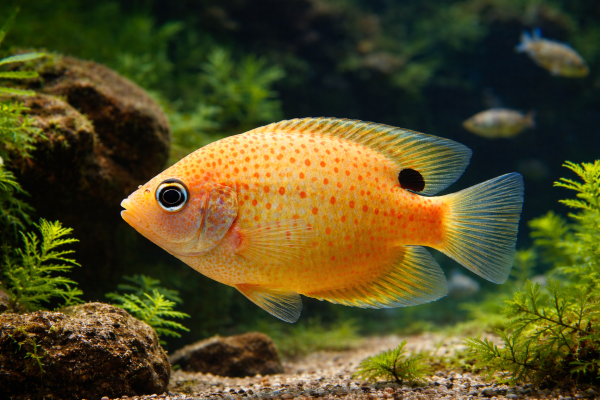
Sri Lanka is home to many beautiful freshwater fish species. One of the most attractive among them is the Orange Chromide, known in Sinhala as අසෝක පෙතියා. Its scientific name is Etroplus maculatus, and some scientists also refer to it as Pseudetroplus maculatus.
This small and colourful fish lives in both freshwater and brackish water habitats. Its bright orange body and peaceful nature make it popular in aquariums around the world. Beyond its beauty, this fish plays an important role in Sri Lanka’s aquatic ecosystems.
Natural Habitat in Sri Lanka
The Orange Chromide lives mainly in lowland freshwater streams and coastal lagoons. You can find it in estuaries where river water mixes with seawater. It also thrives in marshes, canals, and slow-moving rivers.
Popular locations include Negombo Lagoon, Muthurajawela Marsh, and Batticaloa Lagoon. These wetlands provide ideal breeding and feeding grounds.
Unlike many freshwater fish, this species tolerates changes in salinity. It can survive in both fresh and slightly salty water. This adaptability helps the species spread across different regions of Sri Lanka.
Healthy wetlands support stable populations of this fish. Clean water and aquatic plants help them grow and reproduce successfully.
Physical Appearance and Size
The Orange Chromide grows up to about 8 to 9 centimetres in length. Its body has an oval shape and appears slightly flattened from the sides.
The fish displays bright orange or golden-yellow colours. Small reddish spots cover its body. Some individuals show faint vertical bands depending on their environment.
Wild specimens often show softer, natural tones. Aquarium-bred varieties usually display brighter colours. Transparent fins with a light orange shade add to its beauty.
A small black marking near the dorsal area often appears in mature fish. This unique pattern makes identification easier.
Feeding Habits and Diet
The Orange Chromide follows an omnivorous diet. It eats both plant matter and small animals.
In the wild, it feeds on algae, tiny aquatic plants, and zooplankton. It also consumes insect larvae and small crustaceans. Sometimes, it eats fish eggs and larvae.
This feeding habit helps control algae growth in lagoons and rivers. It also maintains balance within small aquatic ecosystems.
Interestingly, this fish sometimes removes parasites from larger fish. It performs a cleaning role, especially with species like the Green Chromide. This behaviour benefits other fish in the same habitat.
Breeding and Parental Care
The Orange Chromide shows strong parental care. Many fish species do not protect their eggs, but this one does.
A male and female form a breeding pair. They select a flat surface or clear a small area for spawning. The female lays around 150 to 250 eggs.
Both parents guard the eggs carefully. They protect them from predators and fan them with their fins. This movement supplies oxygen to the eggs.
The eggs hatch within a few days. After hatching, the parents continue to protect the fry. The young fish stay close to their parents during early development.
In some cases, the fry feed on a special mucous layer from the parents’ skin. This behaviour increases survival rates. Strong parental care gives this species a clear advantage in the wild.
Behaviour and Social Structure
The Orange Chromide behaves in a peaceful and social manner. It often swims in small groups outside the breeding season.
During breeding, pairs defend their territory. However, they rarely show extreme aggression.
Their calm nature makes them suitable for community aquariums. Fish keepers value them for their friendly behaviour and bright colour.
Ecological Importance
The Orange Chromide plays a vital role in Sri Lanka’s wetland ecosystems. By eating algae, it prevents excessive plant growth. By feeding on small organisms, it helps maintain ecological balance.
Wetlands support biodiversity across the island. Fish, birds, reptiles, and plants depend on these environments. The Orange Chromide contributes to this complex food web.
However, environmental threats continue to affect wetland habitats. Pollution from agriculture and industry reduces water quality. Urban development destroys marshlands and lagoons.
Protecting wetlands ensures the survival of this species. Conservation efforts must focus on clean water and habitat protection.
Importance in the Ornamental Fish Industry
Sri Lanka has a strong ornamental fish export industry. The Orange Chromide ranks among popular native species.
Its small size, bright colour, and interesting breeding habits attract aquarium hobbyists worldwide.
Responsible breeding programs help reduce pressure on wild populations. Sustainable practices ensure long-term survival.
Scientific and Evolutionary Significance
Most cichlid species live in Africa and South America. However, Etroplus species exist only in Sri Lanka and southern India.
Scientists study these fish to understand evolutionary history and continental drift. Their presence provides insight into ancient geological connections.
Research on this species continues to expand knowledge about fish adaptation and biodiversity.
Cultural and Local Recognition
Local communities recognize this fish as “අසෝක පෙතියා.” Rural villagers often see them in canals and paddy field waterways.
The species forms part of Sri Lanka’s natural heritage. Protecting it means preserving biodiversity for future generations.
Conclusion
The Orange Chromide (Etroplus maculatus), known as අසෝක පෙතියා, stands out as one of Sri Lanka’s most beautiful native fish. It adapts well to freshwater and brackish environments. Its vibrant colour, peaceful nature, and strong parental care make it unique.
This species supports ecological balance in lagoons and rivers. It also contributes to the ornamental fish industry.
Although it is not currently endangered, habitat protection remains essential. Clean wetlands will ensure that future generations can continue to admire this colourful jewel of Sri Lanka’s waters.