OH TO BE AN ENGINE DRIVER – By Victor Melder
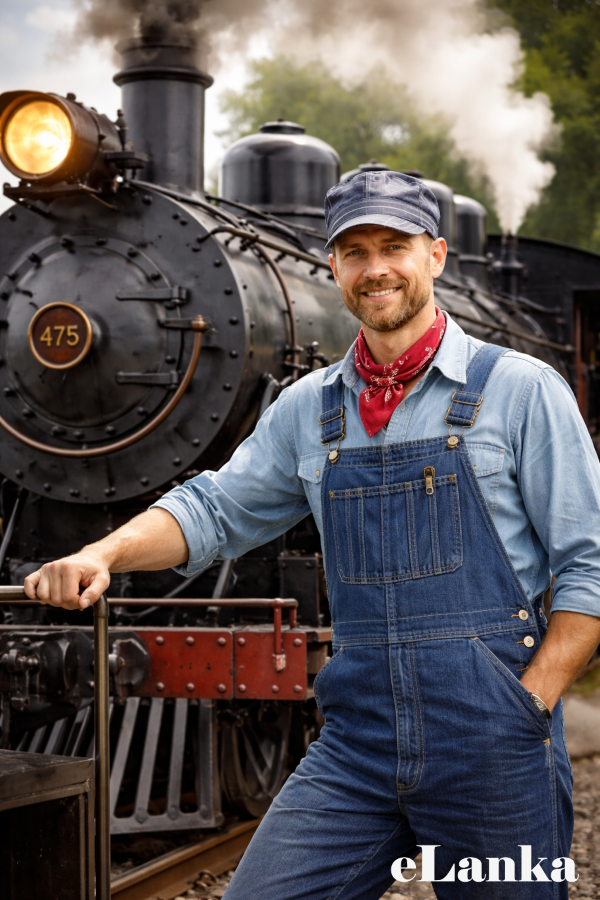
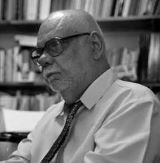
Once upon a time, when steam was King, it was every young boy’s dream to become a steam locomotive driver. Mine was no different, it was heightened by the fact that my father was an engine driver too. Unfortunately, with dieselization and the disappearance of the steam loco, this dream has now vanished for most young boys.
My grandfather, Victor Melder, was a Guard on the Ceylon Government Railway and served from 1897 to 1926, when he passed away prematurely of a heart attack. My father, Randolph Melder, served the railways as an Engine Driver from 1923 to 1963.
It was a colonial tradition, that sons of employees in many services were given preference to employment in the field of their father’s occupation. This was also true with the railways, where sons of railway men had preference. It was argued that with their father being a railway man they would be aware of the vagaries of the job and therefore be more suited to it.
I had to wait until 1956 before I was to realize my dream, but was able to get in by about thee months, as the cut off point was 21 years and had the recruitment program been initiated three months later, I would have missed out on the age criteria.
The recruitment notice specified the candidates should have passed the Senior School Certificate, (English) its equivalent or higher, but for sons of past or present employees of the Ceylon Government Railway (CGR) the Junior School Certificate (English) or higher. Railway Firemen with adequate experience, Seventh Standard (English) or higher.
Other criteria, was that applicants must be of good physique, height not less than 5 feet 5 inches (without shoes or socks) and chest measurement not less than 33 inches (normal). Appointment was subject to a medical examination and eyesight test.
Selected applicants would be on probation for three months. Provided their work and conduct during this period are satisfactory, they will be retained in service and indentured for 5 years apprenticeship. Written tests will be held at the end of 8 months training and again at the end of the second year of training to assess the suitability of the trainees.
During the period of apprenticeship, they must attend instruction classes and perform whatever duties may be detailed. They are subject to the authority of the drivers whom they are booked to work with.
Rate of Pay of the apprentices are:
First year Rs 2.20 per day
Second year Rs 2.60 per day
Third year Rs 3.00 per day
Fourth year Rs 3.40 per day
Fifth year Rs 3.80 per day
On completion of training, apprentices will be required to pass a theoretical and practical test to prove their suitability for appointment to the grade of Engine Driver, Class III, to fill any existing vacancies. Those who fail the test will be re-examined at the end of another year. Failure in the second test will tender an apprentice liable for discontinuance.
Applications for apprenticeships closed on June 21, 1956. I was interviewed by a panel of three (which included Mr Maxwwell Sparkes, C.C.S,who was seconded for Railway service) on 18 September 1956 at the General Managers Office, C.G.R., Colombo. A fortnight later I was informed by post that my application and interview had been successful and that I report for duty on 9.00am on October 16,,1956.
As I lived at Nawalapitiya at the time of application, I had to attend a medical examination and eye sight test at the Kandy General Hospital, prior to taking up duties. Needless to say, this was successful. And so began an arduous and rigorous training schedule, which in my case was extended by eight months, due to the fact that I was eight months off work, having contracted Infective Hepatitis in 1958, having drunk contaminated water off a steam locomotive tender. The department was kind enough to allow me three months light duty (off the footplate) giving me time to recover further.
There were fifty apprentices recruited and we were given the title Special Apprentice Driver (SAD), we were numbered from 51 to 100 (don’t ask me why), and my official position was SAD 63. The title Special Apprentice was because we were being trained on both steam and diesel locomotives. A normal steam apprenticeship was of four years duration, in our case an extra year was tagged on for diesel locomotives. (See Appendix No 1)
Of the fifty apprentices appointed, one was a complete outsider, twenty two were sons of railway men and twenty seven were firemen promoted from the ranks. Before appointment as Engine Driver, one went AWOL, two (from the ranks) were demoted for falsifying education certificates and one failed the eye test, whilst three immigrated to UK and Australia, leaving only the balance forty four to pass out as engine drivers.
The first three months were quite a novelty indeed, working in the sprawling Dematagoda Running Shed, acquainting our selves with the various steam locos in service. The daily grind consisted mainly in cleaning the boilers and tenders of the locos and also checking the under carriages of the bogie tables by working in the pits, as this was the only access to them. It was a mundane 7.00 am to 4.00pm job, with an hour off for lunch from 11.00 to 12 noon. We worked a five day week, plus half day Saturday. All the apprentices were deemed fit to carry on their training and had to sign the indenture papers (see Appendix 2)
THE PITS were dangerous places to work in, they were about 4 to 5 feet deep, had a few inches of water running through them constantly and plenty of oil that had drained off the locos, whilst being serviced, so one had to step very gingerly. As these were locos that were in steam, one had to be wary of falling embers. The bogie tables, generally had ash and other grit that had to be scarped off and oiled. Occasionally one would find pieces of putrefying flesh from animals hit by the locos whilst ON THE RUN.
The next three months was working with an assigned fitter on the various locos, carrying minor repairs, again this was a day job, with Sunday’s off. The following three months were indeed an eye opener as we were assigned as fireman on the steam shunting locos working round the clock, seven days a week at both Maligawatte Yard and Colombo Goods Yard (between Maradana and Fort Stations).
The shunting locos at Maligawatte Yard worked in the carriage stabling yard, were passenger trains were formed and got ready for service. Colombo yard, was mainly a goods or freight wagon yard again where goods trains left from and also arrived from the out stations. As such there was an inwards yard and an outwards yard. There was constant movement at these yards both by day and night. It was interesting firing these shunting locos, where the pace of movement was slow and easy, preparing one for the hectic pace on the footplate for the passenger services.
The next three months, saw us once again in the Dematagoda Running Shed working with the fitters on heavy and large repairs. This section of the work was with locos that were out of service, unlike the second three months, which were mainly running repairs. This was again a mundane job of five and a half days. All of sudden the first year had come to an end, combined with the practical work, the lectures and demonstrations, one had by now a working knowledge of seam locos and was trained to carry out minor repairs, so much so, as to be able to nurse a disabled loco home, rather than seek assistance enroute.
The start of the second year, saw work on the footplate of passenger trains begin. The first for months was in the role of the second fireman on the open line. The duties were mainly to ensure the head fireman had an adequate supply of coal readily available on hand for firing whilst on the run (all coal had to be broken down to the size of one’s fist for easy firing and ignition).
The duties also included assisting in watering the locos at watering points enroute and also checking when possible that the lubrication points were (outside the loco) in order and topping up with lubricants when and where necessary. One was also expected to keep a sharp lookout whilst on the run, which included the position of signals etc.
The next four months saw us graduating to the role of head fireman. In the case of the lower steam link, this was a one fireman position, for short distance trains. The duties were combined roles of both head fireman and second fireman. The next four months, saw us in the role of head fireman on long distance trains, with an allocated second fireman. This was a responsible task, always maintaining a steady head of steam and water, and maintaining a presentable footplate. Another year had gone by.
The beginning of the third year, saw us firing on the long distance trains and fast good trains, which seemed to always run at night. One had an assigned Engine Driver to work under and an assigned second fireman, which resulted in team work, to ensure the trains arrived at their destinations on time. A head fireman and second fireman, come on duty at last an hour before the driver did. By the time the driver does come on duty, the loco would have its boiler cleaned or brushed down, watered and ready for take off, with a full head of steam. The driver would carry out a cursory inspection of the loco and be ready to whistle out at the appointed time.
FIRING TRAINS on both Upper and Lower sections, were different to each other. In the Colombo area, where the railway did not encounter much hilly terrain, one had to fire infrequently compared to the constant climbing which required frequent firing of the loco to maintain a steady head of steam and water. On the lower section, express trains were much easier to fire, than stop and start trains, as they did not need that much firing.
On the Upper section, due to the frequency of the firing that took place, the fire-box tend to fill up quickly and half way up the incline, one would have to clean out the excess ashes from the fire box, by rocking the firebox grate to drop the ashes off. This was necessary to enable good ignition and to maintain a bright fire, required for steaming qualities. It was very strenuous and demanding WORK.
The next four months, saw the fifty apprentices temporarily stationed at Nawalapitiya, for upper section service. This was where the Beyer Peacock Garrat locos were in service. Mercifully they had been modified from coal burners to oil burners and only required one fireman, as their was no stoking of the firebox, but a regulator lever operated to control the flow of furnace oil that fired the loco. What looked a laborious task was quite simple indeed, as long as one maintained a steady head of steam for the journey.
THE GARRAT LOCOS, were monstrous locos that were able to haul trains on the incline, that normally two locos did. Whilst a normal loco hauled five carriages on its own, a Garrat loco could haul nine. When passenger traffic warranted it and trains had over nine carriages or had a large number of freight wagons, then a garret loco hauled the train assisted by a loco from behind.
When a train was worked by two normal locos (one pulling, the other pushing) and they reached the summit level at Pattipola (in either direction), the loco pushing (piloting) would travel around to the front the train and be coupled in front the loco already in front and the two locos took the train down the incline. With a Garraat loco this could not be done as the bridges could not take the combined weight. The pilot loco there fore ran down single, following THE TRAIN.
My father was stationed at Nawalapitiya as a senior driver at he time, and it wasn’t a picnic working with him. He believed in the practical side of things and always had the apprentices carrying out some extra duties or the other to acquaint themselves with the loco. I had more than my fair share.
After the four months upcountry, we were back at Dematagoda on the K. V. steam locos. From the sublime to the ridiculous, I would say after the garret locos upcountry. Here the work was much easier and at a slower pace, as the trains did not run at speed like their mainline counterparts. The last two months of the third year saw us on the two types of diesel locos on the K.V. line, the Hunslett and Krupp diesels, which worked the passenger trains. For once this was a ‘cushy, sit-down’ job, doing nothing exciting, but keeping a sharp lookout and exchanging tablets on the run. The third year had come to an end and ‘the light at the end of tunnel was getting closer’.
The fourth year saw us all at the Diesel loco shed at Maradana, which was check by jowl with the Maradana railway station. The first three months we worked with the diesel mechanical fitters and the following there months with the electrical fitters. Heavy emphasis was placed on a working knowledge of the electrical circuits of the different diesel locos in service, to ensure the drivers were able to attend to electrical faults enroute and bring the train home. This was again a period of lectures and demonstrations.
We also spent three months at the Ratmalana workshops, where the diesels were stripped down to the core and refitted after major repairs, to ensure we had a look at what went on inside the many closed and sealed working parts. This was again a 7.00am to 4.00pm day job. Back again at the Diesel shed, Maradana, saw us riding as assistants for the next three months on all the diesel locos in service – The Brush Bragnal (M1), General Electrical (M2), Hunslett locos (G2) and Diesel Rail Cars.
After the final written test on Diesel locos we began our fifth and final year, which was that of shunting engine driver. The first six months were spent at Maligawatte Yard on steam shunting locos and the next three months as shunting drivers on the diesel shunting locos at Colombo goods yard. The final three months were spent as assistants on the M1 and M2 locos working all the fast passenger and mail trains.
I was finally appointed Engine Driver Class III on July 6, 1962, as mentioned earlier I lost eight months of my apprenticeship due to my being ill and had to make up the time up. This appointment was on three years probation, on the initial salary of the scale Rs 1,680 – 72 – Rs 2,184, per annum.
Little did the general traveling public realize that they had well trained and qualified engine drivers working their trains to time
APPENDIX NO 1
Training of Special Apprentice Drivers
1st Year – Dematagoda Shed
3 months – Steam Locos, cleaning and servicing assistant – with lectures and demonstrations
3 months – Steam Locos – Fitter’s assistant
3 months – Steam Shunting Engines – Firing
3 months – Shed Fitting on Steam Locos – Lectures on Safety Rules
Written test to assess suitability of apprentices for further training.
2nd Year – Firing
4 months – 2nd Fireman – Open Line
4 months – Steam Head Fireman, Lower Steam Links
4 months – Steam Head Fireman, Galle, Chillaw & Upper Link
Final test in Safety Rules (Written)
3rd year – Firing
3 months – Steam Head Fireman, long distance trains
4 months – Steam Head Fireman, Upper section (Nawalapitiya)
3 months – Steam Head Fireman, K. V. line.
2 months – Head Fireman, K.V. Diesels – Class P1 and N1
Written test on Steam Locos.
4th year – Diesels
Learning {3 months – Diesel Fitters and Servicing assistants {with lectures and
Circuits {3 months – Electrical Fitters assistant demonstrations}
{3 months – Ratmalana Workshops – Diesel & Electrical Fitters assistant.
Riding on {1 month – Training to be assistant on G2 and D.R.CC (Shunting Loco and Rail Car)
Locos as {1 month – Training to be assistant on M1 (Brush Bagnall Loco)
asst and {1 month – training to be assistant on M2 (General Electric Diesel Loco)
passing out
Final test on Diesel Locos (Written)
5th year – Shunting Drivers
6 months – Shunting Engine Driver, Steam at Maligawatte & Colombo Yard.
3 months – Shunting Engine Driver, Diesel (G2) at Anuradhapura or Colombo Yard.
3 months – M1 and M2 assisting, Colombo, Anuradhapura, Nawalapitiya Links.
Passing Out by Driving Inspector Mechanical to Drive Steam and Diesel Locomotives and Rail Cars
APPENDIX NO 2
INDENTURE
KNOW ALL MEN BY THESE PRESENTS that I, Randolph Johnny Victor Melder, of No 48, Railway Bungalow, Nawalapitiya (hereinafter referred to as the Apprentice) am held and firmly bound unto Her Majesty Elizabeth II, Queen of Ceylon and of Her other Realms and other Territories, Head of the Commonwealth, Her Heirs and Successors in the sum of Rupees Seven Hundred and Fifty (Rs 750.00) lawful money of Ceylon to be paid on Demand in Colombo to Her said Majesty, Her Heir and Successors for which payment to be well and truly made, I do hereby bind myself and my heirs, executors and administrators firmly by these presents.
Dated at Colombo, this 25th day of January, One Thousand, Nine Hundred and Fifty Seven.
WHEREAS by an agreement dated at Colombo on the 16th day of October, One Thousand, Nine Hundred and Fifty Six
AND WHEREAS in and by the said Agreement it was agreed that the said apprentice should prior to his admission to the said apprenticeship enter into a bond in the sum of Rupees Seven Hundred and Fifty (Rs 750.00) as security for the performance and fulfillment of the terms and conditions of the said agreement and for the payment to the Government of Ceylon of all monies expended on or paid to him during the period of training in the event of a breach of any of the terms and conditions of the said agreement.
Now the condition of the above written bond or obligation is such that if the said apprentice shall faithfully perform and fulfill the terms and conditions contained in the said agreement and in the event of any breach of the terms and conditions thereof pay to the Government of Ceylon the sum of Rupees Seven Hundred and Fifty Rupees (Rs 750.00) then this bond or obligation shall be null and void otherwise the same shall be and remain in full force operation and virtue.
IN WITNESS WHEREOF, the said Apprentice hath hereunto set his hand at Colombo this 25th day of January 1957.
- J. V. Melder (signed)
(Signature of Apprentice)
Victor
Friday, 6 February 2026, 8:34 PM, AEDT