

eLanka

Saturday, 28 Mar 2026
  • Home
  • Read History
  • Articles
    • eLanka Journalists
  • Events
  • Useful links
    • Obituaries
    • Seeking to Contact
    • eLanka Newsletters
    • Weekly Events and Advertisements
    • eLanka Testimonials
    • Sri Lanka Newspapers
    • Sri Lanka TV LIVE
    • Sri Lanka Radio
    • eLanka Recepies
  • Gallery
  • Contact
Newsletter
  • eLanka Weddings
  • Property
  • eLanka Shop
  • Business Directory
eLankaeLanka
Font ResizerAa
Search
  • Home
  • Read History
  • Articles
    • eLanka Journalists
  • Events
  • Useful links
    • Obituaries
    • Seeking to Contact
    • eLanka Newsletters
    • Weekly Events and Advertisements
    • eLanka Testimonials
    • Sri Lanka Newspapers
    • Sri Lanka TV LIVE
    • Sri Lanka Radio
    • eLanka Recepies
  • Gallery
  • Contact
Follow US
© 2005 – 2026 eLanka Pty Ltd. All Rights Reserved.
Home » Goodnews Stories Srilankan Expats » Articles » Sri Lanka Cricket: From World Champions to a System in Crisis-by Gamini Goonetilleke

ArticlesDr Gamini Goonetilleke

Sri Lanka Cricket: From World Champions to a System in Crisis-by Gamini Goonetilleke
eLanka admin
Last updated: March 26, 2026 6:22 pm
By
eLanka admin
ByeLanka admin
Follow:
Share
8 Min Read
SHARE
Views: 113

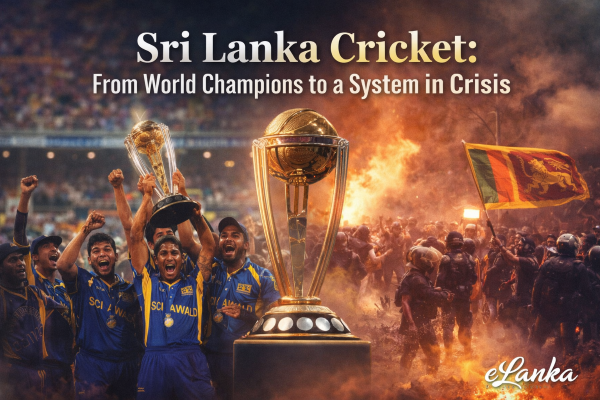
Sri Lanka Cricket: From World Champions to a System in Crisis-by Gamini Goonetilleke

Sri Lanka Cricket From World Champions to a System in Crisis

Cricket in Sri Lanka has never been merely a sport. It has long served as a unifying force, transcending divisions of ethnicity, religion, and class, particularly during periods of national adversity. At its height, it gave the country not only victories, but belief. Yet today, that sense of purpose appears diminished. Sri Lankan cricket is no longer setting standards; it is struggling to keep pace with a rapidly evolving game.

The contrast with the past is striking. The triumph at the 1996 World Cup was not an isolated success but the culmination of vision, discipline, and fearless innovation. Sri Lanka redefined limited-overs cricket with aggressive batting, imaginative tactics, and a collective spirit that elevated the team beyond its individual parts. That identity bold, confident, and united became the hallmark of Sri Lankan cricket for nearly two decades.

However, the modern era, dominated by the demands of T20 cricket and global franchise leagues, has exposed structural weaknesses that were once masked by natural talent and resilience. The game today is faster, more analytical, and more commercially driven. Success depends not only on skill, but on systems including data analytics, sports science, structured development pathways, and professional governance. It is in these areas that Sri Lanka has fallen behind.

Perhaps the most visible symptom of decline is the instability in team selection. Frequent changes in selection committees, shifting criteria, and inconsistent decision-making have undermined continuity. Players are introduced with promise, only to be discarded after limited opportunities. Roles within the team remain unclear, and confidence so vital at the international level is easily eroded. Selection, instead of being a pillar of stability, has become a source of uncertainty.

This inconsistency was reflected on the field. Batting performances lacked clarity and intent. The power play was often underutilized, the middle overs drifted without momentum, and the finishing phase rarely delivered the acceleration required in modern cricket. Against quality opposition, these deficiencies were quickly exposed.

Fielding standards, once a competitive strength, have declined noticeably. Dropped catches, misfields, and lapses in intensity proved costly in closely contested matches. In contemporary cricket, where margins are minimal, such errors are decisive.

Bowling, too, showed signs of stagnation. Opponents, armed with sophisticated data analysis, have been able to anticipate and exploit predictable patterns. While leading teams rely heavily on analytics and strategic match-ups, Sri Lanka has yet to fully integrate these tools into its tactical approach.

Equally concerning were issues of fitness and injury management. Modern cricket demands peak physical conditioning, yet Sri Lanka continues to grapple with frequent injuries to key players. This not only disrupts team balance but also raises questions about workload management, conditioning programs, and the application of sports science. Without a structured, evidence-based approach to injury prevention and rehabilitation, such setbacks will persist.

Closely linked to this is the lack of bench strength. Successful teams are built on depth, ensuring that replacements can perform at the same level as those they replace. Sri Lanka, by contrast, often appears overly dependent on a few individuals, with limited capacity to absorb the loss of key players.

The psychological dimension of the game has also become increasingly important. In high-pressure situations, Sri Lankan teams have at times appeared tentative rather than assertive. This suggests a gap in mental conditioning. In an era of intense media scrutiny and public criticism, players require structured psychological support to maintain confidence and composure. The absence of such support mechanisms is a significant oversight.

Even the advantage of playing at home was not effectively utilized. Familiarity with local conditions should provide a strategic edge, yet recent performances suggest otherwise. Preparation appeared inadequate, and adaptability limited. While public support remains passionate, repeated disappointments tested the patience of even the most loyal supporters.

The challenges extend beyond the playing field. Sri Lanka’s economic constraints have inevitably affected investment in cricketing infrastructure, grassroots development, and high-performance systems. While facilities exist, their optimal utilization and integration into a coherent development framework remain uncertain.

Governance issues further complicate the picture. Concerns regarding transparency, accountability, and continuity within cricket administration have persisted for years. Regardless of the validity of specific allegations, the perception of entrenched leadership and limited reform undermines public confidence. Effective governance is not merely administrative, it is foundational to sustained success.

It must also be acknowledged that the global cricket economy has changed irreversibly. The rise of franchise leagues, particularly those with significant financial backing, has altered player priorities. For many cricketers, the economic incentives of these leagues surpass those of international cricket. Sri Lanka, with comparatively limited resources, cannot compete on equal financial terms. However, it can and must develop policies that balance player welfare with national commitment.

The path forward requires more than incremental adjustments; it demands comprehensive reform. Selection processes must be transparent, consistent, and insulated from external pressures. Domestic cricket needs restructuring to enhance competitiveness and players better prepared for international demands. Investment in sports science, fitness, and injury management is no longer optional but essential.

Equally important is the development of mental resilience through structured psychological support. Coaching systems must function as cohesive units, guided by clear leadership and unified strategy. Above all, governance must be strengthened through accountability, independence, and a long-term vision that prioritize the national interest over short-term considerations.

Sri Lanka’s cricketing history demonstrates that success is possible even in the face of limited resources. What distinguished past achievements was not wealth, but clarity of purpose, discipline, and collective belief. Those qualities remain within reach, but they require deliberate effort to restore.

The risk, if these issues remain unaddressed, is not merely continued defeat. It is the gradual erosion of a cricketing identity that once inspired a nation. Sri Lanka cannot afford to become a passive participant in a game it once helped to redefine.

The challenge, therefore, is clear. To move forward, Sri Lankan cricket must rediscover its foundations while embracing the demands of the modern era. Only then can it hope to reclaim its place, not just as a competitor, but as a respected and influential force in world cricket.




Click here to receive your free copy of the eLanka Newsletter twice a week delivered directly to your inbox!
TAGGED:1996 World CupCricket in Sri Lankaglobal cricket economySri Lankan cricket
Share This Article
Facebook Whatsapp Whatsapp LinkedIn Email Copy Link Print
Previous Article Miller Library to be bigger and better-eLanka LCC MEDIA RELEASE: Miller Library to be bigger and better
Next Article Looking Back at the Waldorf Talks-eLanka 02 Looking Back at the Waldorf Talks-by Dr Harold Gunatillake
FacebookLike
YoutubeSubscribe
LinkedInFollow
Most Read
10 Pictures With Fascinating Stories Behind Them!

“A PICTURE SPEAKS A 1000 WORDS” – By Des Kelly

Look past your thoughts so you may drink the pure nectar of this moment

A Life Hack for when we’re Burnt Out & Broken Down – By Uma Panch

Narration of the History of our Proud Ancestral (Orang Jawa) Heritage. by Noor R. Rahim

eLanka Weddings

eLanka Marriage Proposals

Noel News

Noel News

Noel News

Noel News- By Noel Whittaker

EILEEN MARY SIBELLE DE SILVA (nee DISSANAYAKE) – 29 September 1922 – 6 April 2018 – A Woman of Value an Appreciation written by Mohini Gunasekera

K.K.S. Cement Factory

Dr.Harold Gunatillake’s 90th Birthday party

Sri Lanka's women's cricket squad in Melbourne

Cricket: Sri Lanka’s women’s squad in Melbourne

- Advertisement -
Ad image
Related News
Extreme Heat in Sri Lanka
Articles Bhanuka Nuwan

Extreme Heat in Sri Lanka: Causes, Science, and How to Protect People

Sri Lankan Aluwa Recipe – A Simple Traditional Sweet Delight - By Nadeeka - eLanka
Articles Nadeeka Kumari

Sri Lankan Aluwa Recipe – A Simple Traditional Sweet Delight – By Nadeeka – eLanka

Dilruk Jayasinghe is Sri Lanka's pride at the Australian Comedy Festival. - BY TREVINE RODRIGO IN MELBOURNE.
Articles Trevine Rodrigo

Dilruk Jayasinghe is Sri Lanka’s pride at the Australian Comedy Festival. – BY TREVINE RODRIGO IN MELBOURNE.

New wildlife underpass at Galgamuwa – solution for Human-Elephant Conflict By Arundathie Abeysinghe According to scholars, the new wildlife underpass at Galgamuwa in North Western Province which will be completed this month, will be a solution for the Human-Elephant Conflict (HEC). Galgamuwa is part of the Mahaweli Development Programme, the largest multipurpose national development programme in the country. Currently, construction of the elephant underpass is being completed beneath the railway line at Kasikote, between Galgamuwa and Ambanpola, an area well-known for frequent elephant crossings. A tunnel is constructed beneath the railway track to allow wild elephants to move safely from one side to the other, reducing the risk of train collisions as well as HEC. In 1977, when the Accelerated Mahaweli Development Scheme was launched, vast extents of forest lands were logged to facilitate new settlements. This led to elephants losing their habitats. According to senior engineers working on the project site, “construction work is expected to be completed in March 2026. The project would have been completed in early March, yet, the design phase of the project could not be finalised as there were challenges in controlling the movements of elephants towards the villages. During the rainy season, the slope that had already been cut was filled with water. Hence, those issues had to be addressed prior to its completion.” Galgamuwa residents are of the view that “this is a key project that should have been completed several decades ago as over 300 people have died in the area due to HEC, while over 50 people are handicapped as a large number of houses were damaged by elephants in search of food. For many years, we have spent sleepless nights due to fear of elephants roaming villages at night. One or two officers of the Department of Wildlife Conservation (DWC) cannot handle several elephants at once.” According to environmentalists “due to new settlements, there is lack of food in existing elephant migratory routes. To prevent elephant encounters, majority of villagers have set up electric fences which are useless as elephants cross the fences by felling large trees over them.” “Kahalla-Pallekele sanctuary was declared in 1989 with the objective of declaring the area up to Kala Wewa and Balalu Wewa as a national park. Yet, after this declaration, illegal land grabbing and human activities have disturbed migratory routes that elephants have been using for many years. Subsequent governments dug trenches, thinking that it would discourage elephants from coming towards villages. But that too was unsuccessful. Elephants now destroy electric fences because there’s lack of maintenance. It is difficult for just one or two wildlife officers to manage these elephant fences. When there’s lack of fodder, they go to people’s backyards in search of vegetables and fruits grown in home gardens.” In certain areas of Galagamuwa, community-based seasonal paddy field fences are constructed to avoid HEC. These are very successful as there is a direct incentive for the farmers to maintain and monitor the fence as their crops may be raided by elephants. In 2024, there were around 300 seasonal paddy field fences erected by Farmer Organisations supported by the Department of Agrarian Development. These seasonal paddy field fences contributed significantly to the number of elephant deaths decreasing from 488 in 2023 to 386 in 2024 as people kill elephants mainly when they raid their paddy or vegetable crops. Scholars are of the view that “although, the project would be completed this month, it is necessary to monitor, at least for a period of one year, if elephants may get used to using the underpass, even though they may not use it immediately.”
Articles Arundathie Abeysinghe

New wildlife underpass at Galgamuwa – solution for Human-Elephant Conflict – By Arundathie Abeysinghe

Australia to host U19 women’s tri-series in April
Articles

Australia to host U19 women’s tri-series in April

  • Quick Links:
  • Articles
  • DESMOND KELLY
  • Dr Harold Gunatillake
  • English Videos
  • Sri Lanka
  • Sinhala Videos
  • eLanka Newsletters
  • Obituaries
  • Sunil Thenabadu
  • Dr. Harold Gunatillake
  • Tamil Videos
  • Sinhala Movies
  • Trevine Rodrigo
  • Photos
  • eLanka Newsletter

eLanka

Your Trusted Source for News & Community Stories: Stay connected with reliable updates, inspiring features, and breaking news. From politics and technology to culture, lifestyle, and events, eLanka brings you stories that matter — keeping you informed, engaged, and connected 24/7.
Kerrie road, Oatlands , NSW 2117 , Australia.
Email : info@eLanka.com.au / rasangivjes@gmail.com.
WhatsApp : +61402905275 / +94775882546
  • About eLanka
  • Terms & Conditions

Disclaimer:
eLanka is committed to sharing positive and community-focused stories. We do not publish or endorse political, religious, or ethnic viewpoints. The content published on eLanka, including articles and newsletters, reflects the opinions and views of the respective authors and not those of eLanka. eLanka accepts no responsibility or liability for the accuracy, completeness, or consequences of any content provided by contributors.

(c) 2005 – 2025 eLanka Pty Ltd. All Rights Reserved.